'The kiss' by Picasso.
Outism[1], or...?
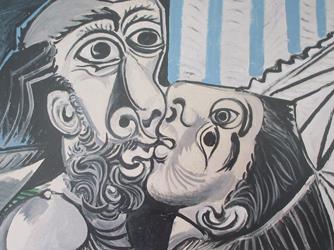
The above screenshot has been taken from ‘The kiss’, P. Picasso[2] (1969), at ‘Metamorfosi’ exposition - Palazzo Reale, Milan (October 18, 2018 – February 17, 2019)
'The Kiss' welcomes the visitor with a calculated vehemence, a programmed effect-driven aggression where the glassiness of the whites of the eyes and the animalistic quality of the wide-open eyes must prevail, along with the almost palpable relief of the sharp outlines, the agitated and uncontrollable gesture, the jarring colors: a hypnotic effect that has enchanted, until today, half a century of admirers all over the world.
In 1969[3], therefore, the passion for Picasso was already a matter of achievement and supremacy, a bullfight between two bulls and no humans, the hallucinated vision of a traumatized child who screams and keeps his distance. It is indeed a painting that does not let you get close, and anyone who does, retreats almost immediately, apologizing: "This painting is easier to understand from afar..."
Picasso was already 88 years old here, having been born in Malaga, Spain, in 1881: he would die in Mougins, France, a few years later, on April 8, 1973. How much time and how much thinking separate this painting from 'Maternity' of 1905?
There he was a moved but not enchanted author, a participant even if not the protagonist, portraying his wife with simplicity while she breastfeeds their firstborn: she is not divine, nor deified, nor is the child deified. She is a woman posing, yes, but without emphasis, a small ring on her ring finger and a red flower in her dark hair, the colours calm and everyday.
Was it the terror of normality? Very brief was that three-year period 1905-1907 that Picasso dubbed the 'Rose Period', in which the man pushed away the genius that the public instead demanded. "When a man watches a woman sleep, he tries to understand..." A period, the one between 1905 and 1907, the shortest of his very long body of work, that soon veered towards the Cubism promoted by Georges Braque, which Picasso would use to push his impatience for life to the absolute limit. 'Maternity' does not appear in this exhibition, although it is titled 'Metamorphoses', which indeed followed one after the other in the production of a man drunk on success, and desperate at thinking to move away from it.
Between 'Maternity' and 'The Kiss' there is 'Minotauromachy' of 1935, which is instead present at the exhibition at Palazzo Reale: it is an etching on copper with little white and much black, crowded with figures and breathless, so much so that one can almost feel its hoarse breath and the slipping away of life, and the little girl holding out a bouquet of flowers is not enough hope. Why so much darkness?
Picasso was already enjoying the abundant fruits of a global success. "When I love a woman, everything weeps, especially my soul..." Capable of an actual revolution that allowed him—thanks also to the choice of a new language—to de-structure reality, Picasso nevertheless managed to propose a 'personal' integral reconstruction of it that defied traditions and exposed the human as a 'normal', agonizing, and vital contradiction, not fearing to let himself be read by the public that acclaimed him with his exaggerations, his excesses, his inhibitions, his many abandonments.
Increasingly involved in the vortex that he would never have imagined when emigrating at a very young age from his provincial La Coruña in Spain, to arrive in Paris. "One must pass through what people see, reality. Tear it apart. Demolish structures..."
"... Women remain in the opposition, in antithesis, and even in Picasso's maturity, when he is by now an established artist, it is strange but there is no woman-ally... The woman remains looked at askance, with suspicion, the woman in freefall... Perhaps it was a defense of his, but at what sacrifice, with what renunciation?"[4]
Picasso's women begin with Maria Picasso y López, the Genoese mother whose surname, Picasso, he decided to take. "Like every artist, I am first and foremost a painter of woman... but for me, woman is essentially a machine for suffering..."
And then the child sister, at whose bedside he himself, as a child, makes a vow that leaves him terrified when she dies, and fate descends upon him like an inexorable, inextricable web: he will be a minotaur forever.
"It's strange..." - confesses Picasso in one of the transcribed phrases that can be read along the path of the Milan Exhibition. "In Paris I never draw fauns, centaurs, or mythological heroes... It is as if they lived only here in Spain...!" Picasso arrived in Paris in his early twenties with very little money and the heavy responsibility of the dreams of his family of origin, and of that Spanish province he left behind where everyone expected something from him, and something great, truly great.
"If all the stages of my life could be represented as points on a map and joined with a line, the result would be the figure of the Minotaur..."
His moving justification for the amorous passion that constantly sustained him and in which he equally took refuge dates back to the Cycladic culture[5]. "I take a vase and make a woman out of it. Using the old metaphor, I exploit it in the opposite direction and give her a new reason for living." The man recognizes himself as the savior of the woman, but with an effort that can suddenly transform him into a monster, thereby justifying his anger.
"The worst enemy of a painter is style." An improbable and winged knight of an utopian Justice in 'La guerre et la paix' of 1952, Picasso instead immersed himself with punitive taste into that mask of the monster that kept him caged. "In the bullfight I identify with the bull..."
And our thinking goes immediately to the unknown 'toreador' of his life, from whom until the very end he tried to save himself: a man, or a woman disguised as a man? But gradually, with growing indifference and an almost heroic self-complacency, the mask of the Minotaur replaced the man whom an immobile and eternal Destiny had caught up with, to attempt to wash away his faults.
The Cycladic women, slow and enormous, are the imaginary companions of the Minotaur; they too serve Destiny, an anchor to cling to in the face of the unexpected and painful abandonments of a hated and transgressed old age. "There is no past or future in art" – Picasso used to say. "If a work of art cannot live in the present, it must not be taken into account at all."
Marina Bilotta Membretti/ Cernusco sul Naviglio – May 2, 2019
TutorSalus.net – Freudian journalism
[1] 'Outing' indicates the public confession of a personal fact or experience, but nowadays it refers specifically to declaring an unresolved homosexuality, with the risk, therefore, of turning into an '-ism', and at times carrying an aggressive connotation.
[2] 'Metamorphosis', the Pablo Picasso exhibition curated by Pascale Picard, director of the Civic Museums of Avignon, was held at the Palazzo Reale in Milan from October 18, 2018, to February 17, 2019. It was part of the three-year European initiative 'Picasso – Méditerranée', promoted by the 'Musée Picasso' in Paris, which also loaned almost all of the works displayed in Milan.
[3] ‘The kiss’ by Picasso dates back to 1969.
[4] The question arose during the visit to the exhibition: Federica Membretti holds a degree in Economics and works as a Data Scientist.
[5] 6th–5th century b.C. / 'Seated Woman' (1920), created after the peak of Cubism and portrying Picasso's future wife, Olga Khokhlova, is also compared to this style of painting.