

Freudian journalism.
A work of economic restitution to the juridical.
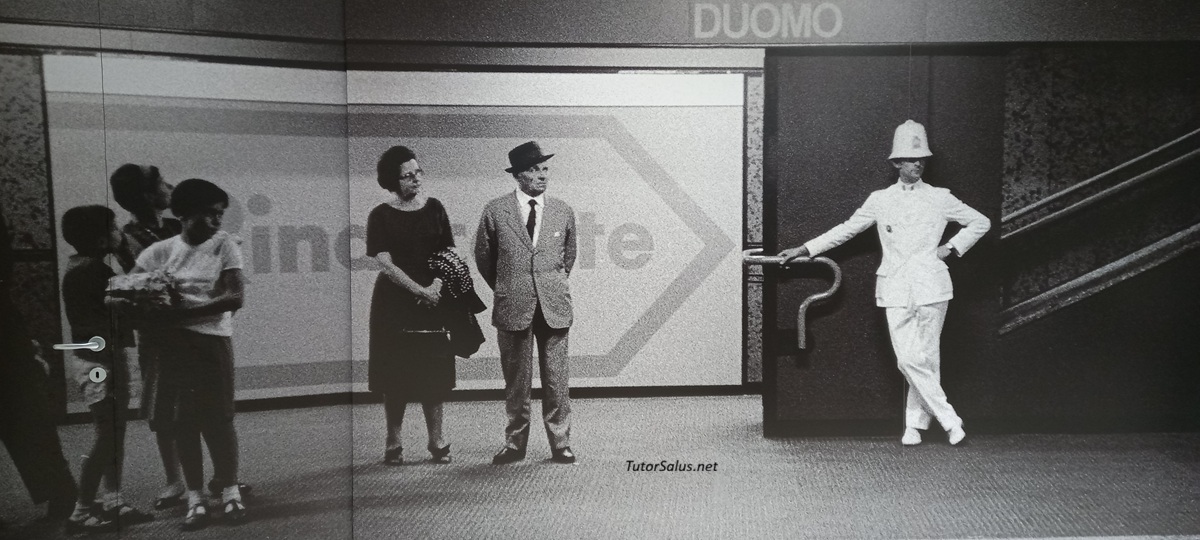
Above: screenshot taken from the exhibition ‘Miracoli a Milano. Carlo Orsi[1] fotografo’/ Palazzo Morando, Milan (31.10.2024 – 02.02.2025).
“We note that ‘Inc’ (Unconscious) does not coincide with one’s removed; it remains correct to assert that everything removed is ‘inc’(unconscious), but not that every ‘Inc’ (Unconscious) is removed. Even a portion of one’s own ‘I’, a portion God knows how important, can be, and indeed is, ‘inc’(unconscious).” [2]
Freud is a laic - that is, neither an atheist nor a gnostic.
He respects an 'unknowing' that can be investigated, but which conscience[3] quickly discards, making one’s own —precisely in doing so—unreliable to the science of thinking, which instead demands all available materials: first and foremost those that are not removed, perhaps having escaped conscience?
Freudian journalism implies a work of economic restitution to the juridical, which conscience rashly neglects - not without an economic damage - when registering one’s own thinking: to judge reliability is not the task of conscience.
Nevertheless, conscience is the definitive thinking, and finally responsible.
Marina Bilotta Membretti/ Cernusco sul Naviglio – September 26, 2026
TutorSalus.net – Freudian journalism
[1] Carlo Orsi (Milan 08.03.1941 – Bergamo 31.05.2021) started as a reporter for the daily newspaper ‘Corriere della Sera’, later dedicating himself to reportage in Italy and abroad for various periodicals (‘Panorama’, ‘Il Mondo’, ‘Oggi’), as well as advertising campaigns, including in the fashion field. In 1965, he published his first book dedicated to Milan, featuring text written by Dino Buzzati, followed by a second book in 2015. In 1984, he held his first photographic exhibition. In 1997, he founded the magazine 'Città', which is dedicated to Milan.
[2] Cited from: ‘Coscienza e inconscio’ in ‘L’Io e l’Es’, S. Freud (1923) – OSF Vol. 9 Bollati Boringhieri, pp.480-481.
[3] “Law is one’s thinking – thinking ‘on’ nature – that has been made memory on a memory already formed by the first experience of satisfaction through Another one. It is conscience outlawed, i.e. outside this law, not in compliance with the law, that opposes one’s memory, and such a conscience is all the more in opposition to the law-memory the more Power’s ambition becomes over one’s law-memory.” Cited from : ‘Inconscio. Precisazione’ in ‘Il pensiero di natura. Dalla psicoanalisi al pensiero giuridico’, by Giacomo B. Contri SIC Edizioni (1998), p.166