

“Paure medievali”
Competence and evocations.[1]
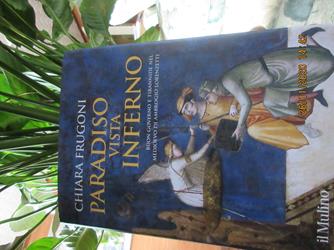
Competence and evocations often meet, perhaps even side by side and despite being contrasting elements: Chiara Frugoni[2] takes up here an issue anticipated in her 'Paradiso vista Inferno' (2019), the convenience of laws which are accessible in their understanding so that a society can tell itself as civilized.
In Padua, in 1305, Giotto depicted 'Iusticia' and 'Iniustitia' in the ‘Scrovegni Chapel’, unable to renounce the religious aspect just yet, but already announcing the weight of 'Vices' and 'Virtues' in the life of the Commune: 'Iniustitia' sits on a throne resting on steep, unstable ground, and would inspire Ambrogio Lorenzetti to place 'Tyrannides' right inside Siena, a city of which he wants to illustrate the results of both good government and tyranny[3].
In these two works, both Giotto and Lorenzetti admitted the need for a mediator between the population and the State which was no longer a mystical revelation: it was therefore up to Governments to draft laws that were as clear and comprehensible as possible, given that travel and movements – especially commercial ones, but also migratory flows from the countryside to the city and from distant countries – were becoming frequent, and people encountered each other much more often than in the past.
For Lorenzetti's contemporaries, there was only 'one' good government: with the 'Studium', or University, in a central position in the city and well-integrated among the artisan workshops, carried out inside houses but out in the open, thus providing a degree that students could – upon graduation – spend honorably.
However, the risk that that very ‘good’ government might slide into the neglect of duties and interests was not uncommon – just as happens in the individuals and even in the children when they improvidently delegate to another, transversal order of which they know little, but which intrigues them with apparently easy paths that require no negotiation: from here – Chiara Frugoni points out – it is a short step to the only possible alternative, which for medieval men is tyranny, a pathologically submissive state for the individual's psyche as well.
Lorenzetti is therefore in favour of making the rules of 'Good Government' a little less opaque, provided it is ruled by a viable system to be used in one's own daily duties and without the intervention of the State: the accountability of a sanction that can also be conceived as a reward would then orient daily life much more productively than a punishing threat.
I would like to insert here a note just gathered from the very recent event #MMT20 'MEETmeTONIGHT' 2020 - the 'European Researchers' Night' and annual showcase of University Research in Italy: it is the very short talk[4] – barely twenty minutes, including questions from the audience – by Prof. Paolo Tedeschi for the Department of 'Economics, Quantitative Methods, and Business Strategies' at the University of Milano-Bicocca: can we, and how do we calculate the quality – which in Italy is extremely high – of a good government in the agricultural field which, in addition to its profitable contribution to the public budget, would grant cultivated lands a surplus of liveability for residents, as well as tourist attraction for everyone?
Marina Bilotta Membretti/ Cernusco sul Naviglio – December 2, 2020
TutorSalus.net - Freudian journalism
[1] ‘Paure medievali’, by Chiara Frugoni - ‘Società editrice il Mulino’ (2020)
[2] Chiara Frugoni is a historian, medievalist, and Italian academic.
[3] Between 1338 and 1339, Ambrogio Lorenzetti depicted , at the ‘Palazzo Pubblico’ in Siena and upon commission by the supreme magistracy of the ‘Nine’ that ruled the city, the three wall frescoes in the Hall of Peace featuring the ‘Allegory of Good Government’ and ‘Allegory of Bad Government’.
[4] ‘Il Covid ed il settore agroalimentare’/ November 27, 2020. Like previous editions, the event ‘MEETmeTONIGHT’ 2020, ‘Faccia a faccia con la ricerca’ (‘Face to face with Research’) involved Italian university cities around a single macro-theme, "The Future," with five thematic areas: Health, Humanities, Smart Cities, Sustainability, and Technology.