

The public debate, including culture, theatre and cinema through the economic perspective of the Freudian journalism.
Events
Sexes in law.[1]
‘The Troyan Women’ and ‘Helen’ by Euripides at the Greek Theater in Siracusa (Sicily, 2019).

My first time at the Greek Theater of Siracusa with performances by Euripides, ‘The Troyan Women’[2] and ‘Helen’[3], also proposed as part of the Conference ‘Love on Trial’ and promoted by ‘Società Amici del Pensiero – Sigmund Freud’, with the patronage of I.N.D.A. ‘Istituto Nazionale del Dramma Antico’.
“I fear the Danaans even when they bring gifts”: the wise Laocoon[4] thus warned his fellow citizens who, fearing Minerva’s wrath, made the Horse enter Troy’s walls, making themselves also the creators of their own misfortune.
In fact, there is a sidereal distance between religious thinking that invokes gifts, and above all the gift of ‘non-work’, and laic thinking which instead picks up the offer of reality and weighs it up with a view to the finish line, giving a value to one’s own elaboration, that is one’s own work.
And there is a suffering that qualifies the religious thinking in one’s own resistance to a laic imputability which doesn’t accept to generalize a human ‘essence’ and to distinguish a ‘sexual sphere’ from others, “that of work first and foremost, the sphere of friendship, the sphere of war, the sphere of politics, the sphere of the ‘private’, the sphere of knowledge and the religious sphere…”[5]
Lazily leaning on the religious thinking, Helen of Sparta - unique among Troy’s noble women who were drawn as slaves after the victory of Greeks – claims to have been the object of divine ambitions – Aphrodite, Athena, and Hera - and thus implores Menelaus, who has come in Troy as a victor. “…Punish the goddess (Aphrodite, n.b.e.), be stronger than Zeus who rules over all the celestials but is Aphrodite’s slave : and instead forgive me…”[6]
And Menelaus, who in his naivety is tempted by comparison with the gods and now falters under Helen’s flattery, in the end he will give up to judge her.
“The discovery should begin to emerge that the abstraction of a sexual sphere is the condition of perversion. The atmosphere of such a… world… is anguish…because anguish is the affection of a defect in the law of ‘motion’…”[7]
The illogical alternative to revenge is giving up one’s judgement : Euripides doesn’t so much condemn Helen’s perversion, whose pitiful words he exposes to the judgement of those present, but rather those who, as and around Menelaus, rejoice in tragedy.
But Euripides also shows how the ease with which Helen manages to ‘override’ judgement, unfortunately becomes a banner among the naive of a presumed and enviable female position which creates a following, and an ‘audience’ indeed.
The princess Cassandra in fact, virgin dedicated to the temple of Apollo and here drawn as the Agamemnon’s future concubine, chants histerically towards Hecuba, her mother :
“Mother, put on my head the crown of victory and rejoyce at my royal wedding; lead me and, if I don’t seem resolute, push me hard. If Lossia exists, the illustrious prince of Acheans, Agamemnon will have in me a wife worse than Helen. Because I will kill him, I will in turn devastate his palace, thus avenging my brothers and my father. Therefore, mother, you must not cry over your homeland, over my beds… I will destroy, with my wedding, our most hated enemies…[8]
To the laic thinking that discards revenge, Euripides dedicates the amazing dialogue between the princess Andromache, Hector’s widow by the hand of Achilles, and the queen Hecuba, Hector’s mother and widow of the ancient king of Troy, Priam, killed first after the assault on the city. Andromache, knowing that she was destined for Achilles’s son, Neoptolemus, so turns to Hecuba :
“…All the feminine virtues that have been identified, I practiced living with Hector… The news of these virtues of mine reached the Achean camp and ruined me : once a prisoner, Achilles’s son, Neoptolemus, wanted me as his wife… If I remove my thinking of dear Hector to open my heart to my current husband, I will appear cowardly to the dead husband. But if I express aversion for the new spouse, I will attract the hatred of the masters… In you, Hector, I had found the ideal husband, you stood out for intelligence, lineage, wealth, value…”[9]
“…Dear daughter – Hecuba turns to his son’s wife - stop thinking about Hector : your tears will not bring him back to life. Instead, honour your new husband, offer him your sweetness. If you act like this, all your loved ones will be happy… and maybe our city could rise again.”[10]
In 423 b.C. Euripides had already performed ‘Andromache’, a dramatic and interesting but little-known text, which presents the woman of a new era, capable of resurrecting from mourning and who had earned esteem and respect from her new husband and his court. But the work had little success at Athens because Andromache was not of Greek lineage.
Then, in 412 b.C. and again at Athens, Euripides will perform ‘Helen’, a tragedy known as ‘tragicomedy’ because the tragic element is not there, if not in the very costly consequences of a naivety neglected for too long.
Marina Bilotta Membretti / Cernusco sul Naviglio – July 4 , 2019
TutorSalus.net - Freudian journalism
[1] ‘Il pensiero di natura. Dalla psicoanalisi al pensiero giuridico’, Giacomo B.Contri – SIC Edizioni (1998), Sez. III 'I sessi nella legge. Sviluppo dell'articolo 8', 'Un'essenza assurda : 'La sessualità', 'Il sesso'. p.131 e segg.
[2] ‘Le Troiane’ 2019 – The Greek Theater of Siracusa, translated by Alessandro Grilli, directed by Muriel Mayette-Holtz, scenic design by Stefano Boeri, costumes by Marcella Salvo, music by Cyril Giroux. With Massimo Cimaglia, Francesca Ciocchetti, Maddalena Crippa, Elena Polic Greco, Clara Galante, Paolo Rossi, Marial Bajma Riva, Elena Arvigo, Riccardo Scalia, Graziano Piazza, Viola Graziosi, Fiammetta Poidomani, Doriana La Fauci.
[3] ‘Elena’ 2019 – The Greek Theater of Siracusa, translated by Walter Lapini, scenes and direction by Davide Livermore, costumes by Gianluca Falaschi, music by Andrea Chenna. With Laura Marinoni, Viola Marietti, Sax Nicosia, Maria Grazia Solano, Maria Chiara Centorami, Simonetta Cartia, Giancarlo Judica Cordiglia, Linda Gennari, Federica Quartana
[4] ‘Eneide’ by Publio Virgilio Marone, (Libro II, 49)
[5] ‘Il pensiero di natura. Dalla psicoanalisi al pensiero giuridico’, Giacomo B.Contri – SIC Edizioni (1998), Sez. III 'I sessi nella legge. Sviluppo dell'articolo 8', 'Un'essenza assurda : 'La sessualità', 'Il sesso' - p.137
[6] The passages chosen and reproduced here are taken from ‘Le Troiane’ by Euripides, I passi scelti e riproposti qui sono tratti dal testo de ‘Le Troiane’ by Euripides, first performed in 415 b.C. at Athens during the bloody Peloponnesian War, which finally – they say - led the Greeks to question themselves about the devastating consequences of their policies. The tragedy is set in the Greek camp in front of Troy.
[7] ‘Il pensiero di natura’. Dalla psicoanalisi al pensiero giuridico’, , Giacomo B.Contri – SIC Edizioni (1998), Sez. III 'I sessi nella legge. Sviluppo dell'articolo 8', 'Un'essenza assurda : 'La sessualità', 'Il sesso' - p.137
[8] From ‘Le Troiane’ 2019, translated by Alessandro Grilli, directed by Muriel Mayette-Holtz, scenic design by Stefano Boeri, costumes by Marcella Salvo, music by Cyril Giroux.
[9] From ‘Le Troiane’ 2019, translated by Alessandro Grilli, directed by Muriel Mayette-Holtz, scenic design by Stefano Boeri, costumes by Marcella Salvo, music by Cyril Giroux.
[10] From ‘Le Troiane’ 2019, cited.
#If you hadn’t been here#
Antonello Da Messina and his cultured reporter.
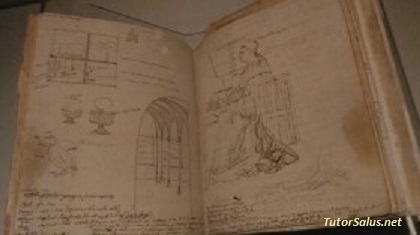
One of the original note-book by Giovan Battista Cavalcaselle, presented at the exhibition of ‘Palazzo Reale’ in Milan, here with the reconstruction which allowed the art critic to attribute with certainty the "San Girolamo nello studio" (1474-1475) to Antonello Da Messina. The enlargement of details from Antonello’s Da Messina works and now being at the exhibition of ‘Palazzo Reale’ in Milan, are by the ‘Centro di Ateneo di Arti visive’ of the ‘Università degli Studi’ of Bergamo.
With the loving gaze of a son who proved himself, Giovanni Carlo Federico Villa(1) did care the exhibition now being at ‘Palazzo Reale’, and named after Antonello Da Messina.
We are very interested in following the thinking of this cultured and passionate Curator, as he realized and got that special love that surrounded the master Antonello, not a ‘massive’ love indeed nor shouting but clearly perceptible at his contemporaries – we don’t refer only to Jacobello, Antonello’s son who finished and signed the magnificent "Madonna col Bambino", just sketched by his father, who was dead one year before : " 1480 XIII Mesis Decebris / Jacobus Anto.lli filiu no / humani pictoris me fecit(2)".
As a matter of fact, of Antonello Da Messina it can be said that he knew how to move in the real, while he knew thoroughly the reality itself.
Giovanni Carlo Federico Villa so introduces in this special exhibition someone who, four centuries after, at the end of '800 acted as a son who cares with passion and patience to reconstruct a hidden heritage which was proving not only to be unvaluable, but also indispensable to understand the novelty of the Renaissance and its future weakness too…
It’s about Giovan Battista Cavalcaselle, passionate historian and a qualified critic who was able to recover and inventory mostly of the Sicilian painter’s surviving paintings, as survivors to earthquakes and floods or stolen too, or even covered and to someone else falsely attributed (3). The exhibition places ahead the work of the man – i.e. both of the painter and of the historian-critic – instead the final object which would risk to end into a collector’s bulimia.
Several works by Antonello Da Messina were destroyed in the 1693 earthquake in Sicily. Then the 1860 flood wiped away even the Antonello’s humble tomb, at the Friars Minor church "Santa Maria del Gesù" where he himself, surprising his fellowes citizens, called to be buried. And already in life he had aroused astonishment, marrying in 1455 Giovanna Cuminella, widowed with the daughter Caterinella so that he could buy a dowry for her, even financially committing himself.
Giorgio Vasari dedicated a biography-romance to Antonello Da Messina in his "Vite" (1550-1568), indicating him as the one who bewitched 'Giovanni Da Brugia', i.e. the excellent Flemish Jan van Eyck from whom Antonello would have received the secret of oil painting. Cavalcaselle so was able to understand that, after staying at van Eyck until he died, Antonello didn’t immediately come back to Messina, from which he had suddenly leaved stopping his good worksop business but, as a matter of fact, he moved to Venice with all his family.
And right in his Sicily, governed by Alfonso D’Aragona and the nerve centre of Europe in 1430 both for trade and culture, Antonello knew those excellent technicians works who were the Flemish artists for the Art to come. Suddenly he had decided to go and meet them in person, with the invincible charge of a wise intuition.
Around 1860 Cavalcaselle - who previously had been entrusted by a London publisher to carry out field researches for a critical edition of “Le vite” but the job proved too big to handle – received a new assignment from the Ministry of Education to draw up a Catalog of the church-owned works of art in Umbria and Marche : the historian could build a large inventory which deserved him the appellation of Vasari work ‘continuer’.
Really provided of an exceptional visual memory as well as an excellent draftsman, Cavalcaselle suceeded in attribute with certainty to Antonello Da Messina a number of works which seemed vanished or fakes, and as a consequence he literally traveled on foot or by mule for kilometres and kilometres between Museums, private and public Art Galleries and Churches, animated by a sincere passion which still today would excite us.
His own notebooks, full of strokes taken from Antonello’s works which he could easily link to those of other authors who met or had been working with the master and become little at a time his own ‘navigator’, allowed Cavalcaselle to reconstruct and at last to locate the routes made by Antonello even out Italy bounds(4), as well as the works carried out over the years but now obscured by the rough of forgery and oblivion.
In the path suggested by the exhibition we suddenly face "L'Annunciata"(5), taken up by Antonello at the end of 'meritatio'(6) when Mary, overcome the fear and perplexity of an announcement of which she offers to us only the certain elements – i.e. she herself and the book opened at the page she was reading – she ‘thinks’ possible the real she guess and she receive it.
Maybe the first woman in paintings History, this young Sicilian lady can allow herself to approve her own intuition – or project we don’t know : her innocence and glance with satisfaction don’t let any doubt. Not at all we face an ‘angelic woman’ of the ‘courtly’ tradition(7) and that causes the comparison with “The Virgin reading” (1460) (8) which has a well distinct Flemish flavour even in the melancholic transparence of her face and is light years away from this innovative Madonna.
We can wonder what happened in the refined thought of the Sicilian master who, overcoming his own aesthetic talent and technical skill, attributed with unsuspected vigour and already at the end of his career, to a well connoted face and also recognizable maybe, that intelligent and imputative look, even with a nod of veiled satisfaction which he so often portrayed only on virile faces(9).
However Antonello’s devoted fidelity dedicates to Christ a completely different register, and to the many interpretations that see him suffering, caught in the sudden temptation of having been abandoned by Father...(10)
Perhaps much still remains to be investigated into Antonello Da Messina’s work because he - in the early turbulent Renaissance in which he lived – was already able to wonder if the absurd guilt indeed of which Christ was accused, wasn’t his own fault of kneeling in front of the woman he didn’t knew. (11).
Marina Bilotta Membretti / Cernusco sul Naviglio - May 30, 2019
TutorSalus.net - Freudian journalism
- Giovanni Carlo Federico Villa (Torino, 1971) is teacher of ‘Storia dell’Arte Moderna e Museologia’ at the Faculty of ‘Scienze Umanistiche’ at the ‘Università degli Studi’ of Bergamo, where he is director of the ‘Centro di Ateneo di Arti Visive’. He is art historian and Art and History consultant at the ‘Direzione dei Musei Civici di Vicenza e Conservatoria dei Pubblici Monumenti’. He cared for the ‘Scuderie del Quirinale’ in Rome the exhibtions : ‘Antonello da Messina’ (2006), ‘Giovanni Bellini’ (2008), ‘Lorenzo Lotto’ (2011), ‘Tintoretto’ (2012), ‘Tiziano’ (2013) e ‘Antonello da Messina, pittore non umano’ a Palermo (2018), now being at Milan until the next June 2. He personally cared exhibitions at Bruxelles, Moscow and Paris. He published for Einaudi ‘Venezia, l’altro Rinascimento’ (PBE Arte, 2014).
- “1480 del mese di dicembre, Jacobo figlio di Antonello, pittore non umano mi fece”, is the autograph reported down on the right on the label of ‘Madonna col Bambino’ at the ‘Accademia Carrara’ of Bergamo.
- Giovan Battista Cavalcaselle, Italian historian and critic, participated in the Revolution of 1848 and for that he was condemned to death by the Austrians, he run away from ‘Lombardo-Veneto Realm’ to Rome where he fighted under the leadership of Giuseppe Mazzini. After the fall of the ‘Repubblica Romana’, he took refuge in England, working as an excellent draftman and restorer in the ‘Select Committee’ of the National Gallery in London. He expressed doubts on the traditional attribution, he imputed without hesitation the work ‘San Girolamo nello studio’ to Antonello da Messina and between 1857 and 1861 he came back to Italy where the political situation had become favourable again.
- In 1476, called by Leonardo Da Vinci to the Court of Galeazzo Sforza, enlightened but intemperant Duke of Milan, Antonello Da Messina preferred to remain in Venice where he already was working : a few months after, when in December of the same year Galeazzo was killed due to a conspiracy of noble men with consequent dramatic turmoils in the town, Antonello came back directly to Sicily.
- The work (1475-1476) is permanently located at ‘Palazzo Abatellis’ in Palermo.
- ‘Meritatio’ is the fourth moment, ending the ‘L’Annunciazione’ and preceeded by : ‘conturbatio’, ‘interrogatio’, humiliatio’.
- ‘Court woman’, or ‘Court lady’ from Latin ‘domina’. She’s the woman sung in the romances of ‘courtly love’ in France, from where it spread starting from the XII century as a reaction to the social rigidity of customs : she’s the woman whose beauty blinds the man who submits to her without any reward, an ecstasies indeed.
- Dated 1460 and attributed to Antonello da Messina, ‘The Virgin reading’ is in Milan, at the ‘Museo Poldi Pezzoli’.
- First of all I think of the ‘Portrait of a young man’ (1473-1474), London – The National Gallery; but also of the ‘Portrait of a man - Trivulzio Portrait’, (1476) Turin – ‘Palazzo Madama’, ‘Museo Civico d’Arte Antica’.
- ‘Ecce homo’ (1475), Piacenza – ‘Collegio Alberoni’; ‘Ecce homo’ (1468-1470), Genoa – ‘Galleria Nazionale di Palazzo Spinola’; ‘Cristo alla colonna’ (1478) Paris, ‘Musèe du Louvre’.
- Thanks to prof. Giovanni Carlo Federico Villa at whom I could listen in the introduction of last April the 11th, at the ‘Sant’Andrea Apostolo’ church at Bergamo Alta, on invitation received by the parish Don Giovanni Gusmini. And afterwards I’ve listened him in Milan, during his own introduction at ‘Palazzo Reale’ lasto May the 4th.
Albrecht Dürer[1].
The effectiveness of beauty in reality.
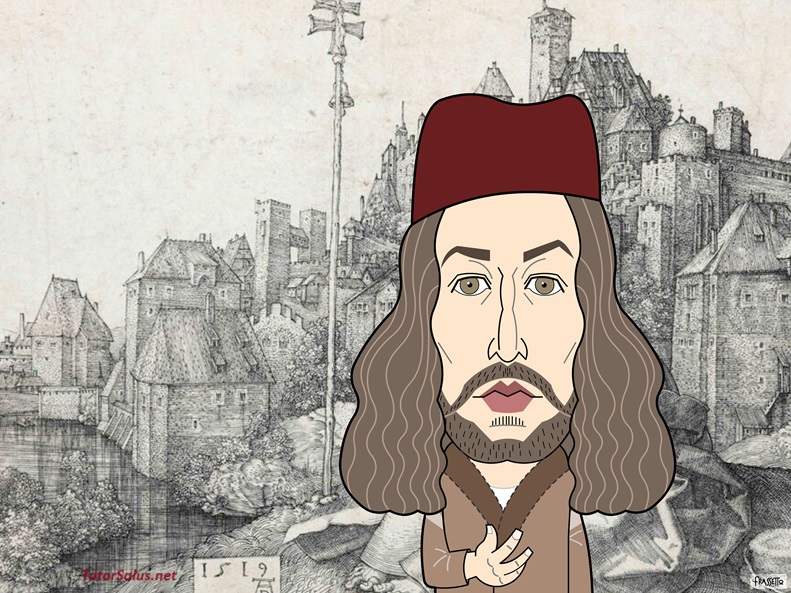
Original painting by Stefano Frassetto (5).
“What the beauty is I don’t know… There isn’t one that is not susceptible to further refinement…”[2]
Dürer was not an isolated genius but a cultured man, well introduced in the German society from which, however he could take distance with that refined expertise which made him a reliable interlocutor of those powerful patrons who called him, and without attracting the distrust which instead his contemporary Leonardo Da Vinci surrounded himself.
Son of the goldsmith Albrecht, named ‘the Elder’[3], since childhood Dürer was an excellent draftsman and with a keen talent for portraiture : soonest he began to cooperate wth scholars and printers in the nascent and promising editorial environment in Nuremberg, until he decided to switch to the difficult – and impressive – art of engraving, to which he would even entrusted the fold of the face of a mocked Christ in ‘Passion’ (1497-1510), and also the perverse shades of envy on the men in ‘Christ at twelve among the Doctors’ (1506).
However it was the religious question of that period, between the emerging Protestant Reformation – maybe launched by a loan of the Fugger Family to the Archduke of Tyrol in 1487, granted by a mortgage on the silver mine of the Archduke – and the following Counter-Reformation, which started in Dürer man a question not to be disregarded, the one of a unique individual thinking, not divisible between rationalism and mysticism, uniqueness that is removed only through short-sightedness, making the human turn pale into a rigid servile dull mechanicalness which, shifting and shifting, will be culminating into the Nazi insanity of a few decades ago.
It is a most severe criticism by Dürer, even is well-educated, hardly counterable due to its captivating sophistication, against the German and contemporaries artists, first of them the brilliant politician Lucas Cranach, piainter of Reformation and friend of Martin Lutero with whom Dürer was cooperating at the beginning. Just look at the different interpretations of St. Jerome, a model for the humanists at the crossroads between Protestants and Catholics.
The art of Dürer came to face the art of our Leonardo Da Vinci, for whom the old age of St. Jerome was only penance and loneliness, while Dürer was describing a saint and smiling old man, gladly aware.
In his own loyalty to the classsic canons, re-examined thanks to the rediscovery of artists like the painter Apelle, named by Plinius the Elder as capable to reproduce visually sounds and scents, Dürer enjoys the extraordinary individuals painted by Giorgione, Tiziano, Lotto and by Leonardo Da Vinci himself building in turn on the excellent Italian Colleagues’ achievements. He’s prepared the ‘Renaissance’ indeed, through his proverbial curiosity towards a real he deemed reliable even in his own old age, and in the effort of life that can always be processed.
At last he landed to his most puzzling work, “Melencholia” of 1511, where the leading character is the artist himself, as a processor of reality, without any other satisfaction than the work itself and the work in progress indeed. Dürer daringly themes the artist ‘fury’ as he can investigate the desorder of the world coming even to establish an order[4] thanks to the tools of logic at his disposal, but then he is alone when anticipates his contemporaries concluding a work that is inviting, for the world itself wants and is disposed to it, even if is still a project and not yet an experienceable reality.
Loneliness breeds ‘melencholy’ Dürer suggests, while pointing out the risks of a modern Ideal of sexual autonomy, already present in the authors of ‘Reformation’.
The liking of Dürer for the perfect monstrosity of “ Marine crab” (1495) which lets be admired without resistance is that of a curious man and fond of reality, not contaminated by prejudices but attentive student of the classic and measurable canons.
It is the same liking which you find again in “The satyr family”(1505), a ‘faun’ as wild as tender husband as well as a caring father in a quite different family compared to that where the educational rigour forges indeed risky weaknesses and inhibitions ready to explode.
Finally, it is an application sympathy, the one focusing the mistrustful judgement of Dürer towards an emerging social submission in Europe – favoured by the Culture of the contemporary ‘Reformation’ by Martin Lutero, to whom however Dürer will approach in the last years of his life – ready to generate real monsters, pale and lucid executors of anything they don’t share nor love, hating the even mild individuality of a child when he asks questions to which the adult has given up answering.
Marina Bilotta Membretti / Cernusco sul Naviglio – September 8, 2018
TutorSalus.net - Freudian journalism
[1] I owe the discovery of Albrecht Dürer (Nurberg 1471-1528) to a welcome surprise by my daughter : the visit to the exhibition in Milan “Dürer ed il Rinascimento fra Germania ed Italia” (a cura di B. Aikema) at ‘Palazzo Reale’ (February 21 – June 24, 2018).
[2] “Dürer”, edited by Costantino Porcu – Rizzoli Editore Milano (2004)
[3] It is of 1490 the “Portrait of Albrecht Dürer, the Elder”.
[4] “Ordine, contrordine, disordine. La ragione dopo Freud”, Maria Delia Contri – SIC Edizioni (2016) : the author specifically deals the theme of ‘disorder’ which precedes and supports any psychopathology.
(5) Stefano Frassetto is born in Turin in 1968. After his degree in Architecture at ‘Politecnico’ he begun as graphic novelist for local magazines. In the ‘90s he edited in France too, on ‘Le Réverbère’ and on ‘Libération’ : then he created ‘Ippo’ for ‘Il Giornalino’ and then the stripe ‘35MQ’ for the swiss magazine ‘20 Minuti’. In 2000 he came into ‘La Stampa’ as portraitist for cultural page and the insert ‘Tuttolibri’, then for the weekly ‘Origami’. Today he works also for the swiss magazine ‘Le Temps’.
Speed Book Date[1] – Varese March 11st, 2018
I’ve presented : ‘La profezia dell'armadillo’[2]

I’ve a parallel passion for authors comics : this summer Marco and Laura – Marco is my third-born twenty-five years old, engaged – gave me this beautiful comic which they really liked, at the end of a few days of vacation together. I read it after they left and laughed so hard, laughing is good for me.
I heard Zerocalcare say – it was at the 2016 ‘Book Fair‘ in Milan. Oh, by the way, Zerocalcare’s real name is Michele Rech, thirty-five years old - that “he never went to the psychologist“. It will therefore be entirely thanks to him if he is capable of communicating with his unconscious – the armadillo, “my imaginary friend that makes easier for me to understand my thinking and ruminations“ – and that we normally remove and find ourselves dealing with daily neuroses ?
Well, in this comic it seems like Zerocalcare lives well with his unconscious. Infact, his Artist 2nd Edition begins with an published comic, in black and white, in which Zerocalcare talks to himself from nine years earlier, when the first edition was published : he sold something like 100.000 copies, but he is still dealing with his nightmare of “being left behind“ and “Is my mother happy ?“ But now, with dignity, this is his job, and his mother – who in the comic has the features of Lady Cocca in ‘Robin Hood‘ by Walt Disney - is happy too.
He just suddenly learned that “Camille didn’t make it“, as the father of the friend he talks about in the first edition writes to him, and he wonders : “Is the one I remember the real Camille or the one from the comic ? Am I still capable of measuring that gap ? Was it right, was it wrong ?“ and then to himself : “Think about these things, don’t treat them like mental blowjobs. Because you’ll carry them with you for a long time.“
He was born at Arezzo and now he lives in Rome, in the Rebibbia Prison district.
“It is called the armadillo’s prophecy any optimistic forecast based on subjective and irrational elements, passed off as logical and objective, destined to increase disappointment, frustration and regrets, forever and ever. Amen.“
Marina Bilotta Membretti - Varese March 11st, 2018
TutorSalus.net - Freudian journalism
[1] Speed Book Date, presentation of a book within five minutes : event in five presentations in different Italian cities, conceived and managed by Alessandra Pagani, editor and blogger.
[2] ‘La profezia dell'armadillo’ Artist 2nd Edition 2017, by Zerocalcare – BAO Publishing