

"Is... is it okay like this?" "Yes, but hurry up, come on!"
Judith[1], in Caravaggio[2] (1599).
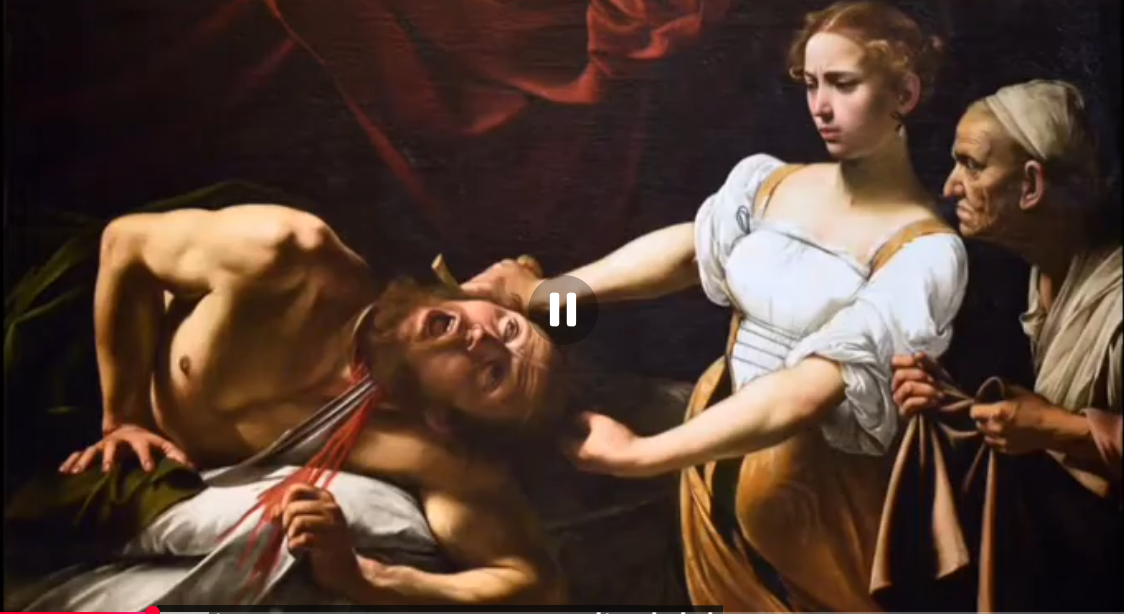
Above: screenshot shared from https://www.youtube.com/watch?v=Fuf1RbbDSlA
The naive innocence of an overly young and impoverished Judith who, perhaps out of hunger, accepted the commission only to find herself lost and disgusted by the blood of the groaning and still-living Holofernes, exposes her—in Caravaggio's interpretation—to the search for a deceptive validation, which she can only seek from the sole prompter present: the helpless old maidservant who is in a rush to finish.
A red curtain, of perhaps dark velvet, falling from above with no apparent support, acts as a watershed between the victim and her persecutor: and the applause undoubtedly goes to the magnificent Holofernes-Caravaggio, a splendid precursor to that 'Grand Guignol' which enjoyed success in Paris for nearly a century. [3]
Called upon to represent that highly controversial biblical passage which entered the Catholic Bible only in the 4th century a.D. in the West—and as late as the 6th century in the East—and which was accepted by neither the Hebrew nor the Protestant Bible, Caravaggio interprets with rationality and realism the uncertain liberation of the Judean city of Bethulia from the siege laid by Holofernes. The Assyrian—meaning Persian—general was under the command of Nebuchadnezzar[4], and his defeat came by the hand of the beautiful, young, and wealthy widow Judith, to whom the salvific—but entirely implausible—role of scapegoat was attributed for a murder plotted elsewhere and by who knows whom: in the painting, Judith, bent by the weight of the iron, is caught holding the heavy scimitar which Caravaggio skillfully depicts, already stained with the blood of another, horrifying her almost like a young maidservant called into the kitchen to slaughter backyard animals for her very first time.
Marina Bilotta Membretti/ Cernusco sul Naviglio – January 17, 2020
TutorSalus.net – Freudian journalism
[1] ‘Judith and Holofernes’, exposed in Rome at Palazzo Barberini/ Gallerie Nazionali d’Arte antica, has been chosen by the psychoanalyst Giacomo B. Contri for the Symposium 2019-2020 ‘Potere e innocenza’/ ‘Studium Cartello’ association, Milan.
[2] Michelangelo Merisi, known as Caravaggio, was born in Milan on September 29, 1571, and died in Porto Ercole in 1610. His parents, originally from Caravaggio (Bergamo), moved to Milan where his father worked as a master in church building sites. Between the ages of 13 and 17, he worked in the workshop of Simone Peterzano (a pupil of Titian) and other masters, though not continuously and despite having a contract. He left Milan in 1592 and never returned. His painting, ultimately appreciated only in the 20th century, nevertheless created the ‘Caravaggism’ movement among his contemporaries and followers.
[3] ‘Grand Guignol’ is the name of a Paris theater (1897–1963) that staged bloody shows with scenes of cruelty, attended by enthusiastic crowds of spectators.
[4] Nebuchadnezzar, known as the ‘king of the Assyrians’ reigned between 605 and 562 b.C.