

Building the city again.
A three-person job.
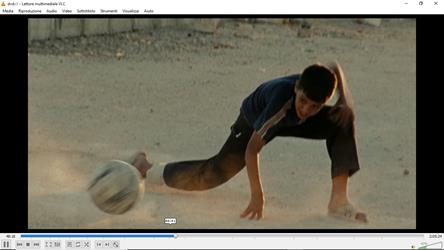
Screenshot from the trailer of the film 'The Hurt Locker' by Kathryn Bigelow (U.S.A. 2008): the young boy Beckham manages to save a penalty kick, winning the bet with American Sergeant Jones.
I start again from Petra[1], an ancient city never forgotten, even if today tourists visit it on organized 'tours' that tell even what would not cross one's mind to ask.
During a work break while filming ‘The Hurt Locker’[2], actor Guy Pearce—Sergeant Matt Thompson, and the first E.O.D. bomb technician to enter the scene—also went to Petra with other members of the crew. He admits with surprise: "Here, people watch you, they don't miss anything you do... Back home in the West, there is indifference[3]”.
The work of an E.O.D. [4] technician is appreciated among the military, but also deeply by those who actually live down there and find bombs literally between their legs when stepping out into the street, buried just beneath old, eaten-away asphalt and stone pebbles. Yet, at the same time, it is a conflicted job, fought rationally and with Conscience by those who truly want those bombs to explode, no matter who gets hurt!
"War is a drug" is the unsettling premise of the film, and an E.O.D. technician is not a hero, in fact. "I wanted to describe the chaos of war...", says Kathryn Bigelow, an intelligent and capable director according to the film's actors, and also the first woman ever to win the Oscar for Best Director in 2010.
"And I wanted to reconstruct 'that' walk, of a lonely man going to defuse the bomb in the middle of the city. I wanted the viewer to take that walk with 'him'... If I succeeded, that was my goal."
"I could only get a fraction of an idea of what an E.O.D. is," confesses Jeremy Renner, who plays E.O.D. bomb technician Sergeant William James in the film. "I wrote pages and pages," he says, "to get inside, to understand...
What is cinema for if not to provoke your thinking or, better yet, multiple conflicting thinking which you didn't have before entering the theater? Or you just pay 11 dollars to be entertained, and you walk out the same as before..."
The film leads us through a surreal and deliberately realistic chronicle-story, but one that is never easy or sadistic. Beckham is the boy from whom Sergeant James buys video games at the market to distract himself after a mission.
"...My name is Beckham" [5], he replies with the boldness of someone who, at just twelve years old, already knows that you must never, 'never', give your identity to the 'enemy'. He accepts James's bet and wins the five dollars promised for saving that penalty kick. And Beckham himself is 'the hurt locker', 'the keeper of what hurts', which for the American military is also the box where objects to be returned to the family are kept when a soldier dies.
Beckham, the child in the hands of 'his' shrewd adults, is indeed near death when James and his squad find him on a makeshift operating table in an abandoned warehouse. Someone among 'his' people clumsily inserted the explosive device into his small chest, and he is dying, bleeding out and useless to the Cause, because even 'that' bomb will be defused by the 'enemy' technician.
But James, after 'this' mission, cannot manage to leave. Alone on the street, he imagines bringing the child back to his family—who isn't there—or at least finding those who wanted to transform him into a body-bomb, as he calls it. Instead, he calls his wife, who answers from the United States holding their few-months-old baby... He cannot utter a word, but it is his wife's voice, it is 'his' home, it is something.
The filthy merchant leaves him in front of a middle-class house, furnished in a Western style. James enters like a thief and finds himself in front of the master of the house: elegant, a professor with an incomprehensible name, who says he knows many languages and invites the American sergeant to make himself comfortable—he is a guest, right? But 'about Beckham, no, he knows nothing...' In his locker under the bunk, along with fragments of the defused devices—eight hundred and seventy-six he had counted—the American sergeant also keeps his wedding ring.
"She is faithful..." he confesses to his comrades who ask him. And she is also the only one to whom, having returned home to the United States after the deployment that does not force him to go back down there, he can say: "They are short on bomb technicians...".
And she, once again, understands. If war is a drug, as the official commentaries on the film state, two languages and messages are offered to the viewer here.
One of them, however—and a truly grave one—can continue to remain encrypted, repressed, or deliberately misunderstood by those who won't even applaud because the story is not sensational, not catastrophic, not exciting enough...
And that message is that war is consoling—the true consoling 'drug' for those who do not take a single step to build peace in their own lives, and to whom a city and the people living in it do not matter, except as objects to keep or to discard.
Hands can think, as a matter of fact: no human, not even an expert bomb technician, can ever be a robot.
Marina Bilotta Membretti/ Cernusco sul Naviglio – June 7, 2020
TutorSalus.net – Freudian journalism
[1] Petra, ‘The Variegated’—as it was called in ancient times due to the vivid colours of the rock layers—is still located in Jordan, south of Amman. At the center of a vast desert area where the only water comes from rainfall, it possessed an exceptional water network of cisterns and channels carved into the subsoil, which the Romans used as a tool of pressure to eventually subjugate it. It was abandoned in the 8th century and ‘rediscovered’ only in the 19th century. The city of Petra is mentioned in the ‘Qumran Scrolls’, among the oldest surviving copies of biblical books (40% of the identified documents) dating back to the period 150 b.C. - 70 a.D. These documents were found in the West Bank only between 1947 and 1956, and they bear witness to Late Judaism, meaning the Jewish Civilization following the destruction of the Second Temple, which was itself the reconstruction of King Solomon's temple.
[2] Presented in Venice at a preview screening in 2008 during the ‘Venice International Film Festival, ‘The hurt locker’ won six Academy Awards in 2010 for Best Picture, Best Director (Kathryn Bigelow), Best Film Editing, Best Sound Mixing, Best Sound Editing, and Best Original Screenplay (Mark Boal, journalist).[3] The dialogue fragments reported here are taken from the 'backstage' of the film.
[4] E.O.D. stands for ‘end of discussion’ (meaning ‘case closed’ or ‘I don't want to hear another word’) or ‘end of day’, indicating something that must be finished by the end of the workday. However, in the Army, it refers to a volunteer technician expert in Explosive Ordnance Disposal. In the movie, the ‘Bravo Company’ squad consists of three soldiers: two support shooters and one E.O.D. bomb disposal expert who goes out alone to defuse the bomb, or bombs.
[5] David Beckam (London, 1978), awarded as the 2nd best footballer in the world in the 1999 FIFA rankings he is still an icon for many very young fans.