

'Madonna of the Alliance'.
An unpublished Giotto.
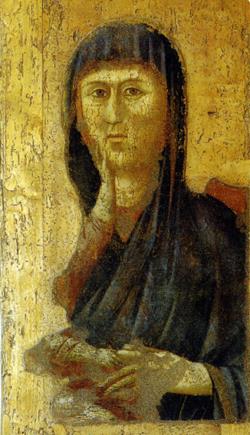
Above photo: screenshot taken from ‘Maestà’ (1290) by Giotto, Pieve di Borgo San Lorenzo (Florence).
An unpublished Giotto presented itself to me on the afternoon of Sunday, November 4th, while I was traveling around Florence: a young librarian from Vespignano, which is Giotto’s birthplace, had pointed out the work to us—a large fragment of a 1290 'Maestà' in the town Pieve of Borgo San Lorenzo, about 30 kilometers from Florence.
The church is beautiful, ancient, simple: upon entering, after a few steps, this panel is clearly visible, soberly framed on the right column before the apse.
Mary's gaze is directed at the visitor, but with an unusual, demanding seriousness, bearing a message completely unfazed by the years that separate us: after a long, precious restoration, it was recently attributed without uncertainty to Giotto[1], who was then just over twenty years old.
Mary lets the child hold her index finger while he caresses her face with his other hand, but her gaze is directed at the viewer and defends marriage—the individual bond that a child attributes without uncertainty to love, and specifically as conjugal love.
Indeed, from that first attribution, it will remain for everyone an essential, though corruptible, reference point for every subsequent goal and achievement: therefore, not to be mocked or trivialized[2].
It is thus, even formally, an alliance, and one that, right from the start, looks not so much at the difference in sex as at the difference in the position of the 'sexes': in short, it also applies to the young daughter toward the woman, it is a satisfied and repeatable desire of the newborn daughter toward the mother, as the desired 'other' relative to her own body.
Very different from the female figures Giotto had accustomed us to - for example, in Padua in the 'Scrovegni Chapel', where he richly sketched the even dramatic motion and beautiful features of Mary, Anna, and Elizabeth - this 'Madonna' instead has stern features and a virile, penetrating gaze: very far from hieratic Byzantine icons, but also from the emerging urban gentlewomen...
What could have been Giotto's thinking here, showing that he knew well the desire of a child and the social threat of its outrage?
This threat passes through the woman, Giotto's wise competence seems to answer, and the generation of a child thus becomes a crucial link between the individual bond indicated by the child and the adult's capacity for elaboration, who is already an adult in society.
In this 'Maestà' it can only be Mary, yet Giotto admits here that the solution of such a woman among his contemporaries was still unthinkable: a woman, indeed, capable of not admitting that female 'lack' that Culture itself blew against him.
Was Giotto afraid of being misunderstood by exposing his thinking and his dismay? The times were not right, Giotto perhaps said to himself, and he chose to wisely defend Mary: but with her, he knew how to defend his own work.
I have therefore called it 'Madonna of the Alliance', perhaps thinking back to another 'madonna' I had observed for a long time in Florence, at the 'Uffizi Gallery', which was the 'Madonna with Child and Angels' from 1465 by Filippo Lippi: delightful, yes, but naive in exposing herself to the insolent mockery of others.
Marina Bilotta Membretti, Cernusco sul Naviglio - November 4, 2018
TutorSalus.net – Freudian journalism
[1] Giotto di Bondone, more simply Giotto, perhaps a diminutive of a longer original name, was born in Vespignano, near Florence, around 1267 and died in Florence in 1337. The painter Cennino Cennini (1370-1427), author of the 'Libro dell'Arte', wrote of him: "He changed the art of painting from Greek into Latin and translated it into modern," referring to Giotto's undisputable overcoming of Byzantine schemes and his introduction of space, volume, and colour, founding values of the subsequent 'Humanism'.
[2] See ‘Inherit from a child. Why not ?’, Marina Bilotta Membretti (2024) NeP edizioni Srls - Roma