

Excellent notes of economic thinking taken from analytical work.
Strawberries
A ‘tortellini machine‘[1].
The hell of Beelzebub[2], with mystics and indifferent people.
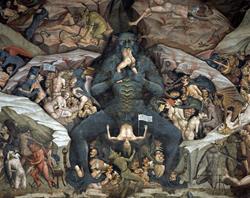
The fresco of Beelzebub in Bolognini Chapel.
“… In case the chapel placed in the church of Saint Petronio, of which the testator himself is supporter, at the time of his death wouldn’t be finished and painted, shoul be carried out by the executors of his will, as follows :
building a double door, the two leaves half closed and half open, as a grating with nails in golden copper and, below, with tondoes including different characters as you can see in the door of Saint Mary of Porta Ravegnana.
The chapel shall then be painted by a good painter as follows : the ceiling shall be light blue, in a good colour of the price of two ducats per pound, with golden stars as you can see in the chapel placed in the church of the Lord of Sabina,
and on the side wall of the same chapel toward the square of the Municipality of Bononia, up to the middle of the wall, shall be painted all the pains of hell, the most awful possible,
and, on the other wall of the chapel, shall be painted the histories of three Magi kings, occupying the whole space…“[3]
On February 10, 1408, almost at the end of the work, Bartolomeo Bolognini so dictated his testamentary wills to the notary Lodovico Codagnelli : descendant from a family of silk makers in Lucca who came to Bologna in the middle of XIII century, as attracted by taxes concessions offered to silk spinners and having great profits by that, in 1.404 he acquired the patronage on the fourth and last chapel in Saint Petronio from the municipality of Bologna which built the basilica.
Bartolomeo Bolognini was not then in his deathbed, and infact the coming years would have kept him aside further satisfactions, notwithstanding he did never engage in politics in those so unsteady years and not only in Bologna, so that his elegant town house – placed near the two spinning machines authorized to draw the hydraulic power for the two mills from Savena channel - could receive distinguished guests both of the town and of the antipopes.
The Church infact was going through, since the death of pope Gregorio XI in 1.378 and the following election of pope Urbano VI, one of the most severe crisis of its history, culminating with the election of the antipopes at Avignone from dissident cardinals who didn’t recognize the legitimate pontifex of Rome, notwithstanding they acted side by side, as if Avignone had its own legitimacy : added to that, in 1.409 cardinal Cossa got to collect a Council in Pisa which led to the election of a third pope, also not legitimated, and named Alessandro V, which in January 1.410 made his entrance in Bologna, so become the third papal seat.
As a supporter of one of the chapels of the Basilica, Bartolomeo Bolognini took charge of an official aim : and we wonder when he points out in his wills that “… pains of hell should be painted, awful the most is possible…“
As a matter of facts, Middle Ages excluded the possibility of Purgatory.
At the center of fresco, clearly visible to the bystanders, here is Beelzebub, a meticulous officer but not able to procreate, lacking any sex : while serving a real Agency, time has gone over on earth where any sinner could still mend his, or her own ways, by judging the evil done.
‘Thinking, a synthesis capacity and specific for humans, here is no more possible, as this is the kingdom of the indifference : and of the no-difference, among sexes, too.
The betrayers – as Judas and Brute – are the most bitterly punished, in their own indifference to the benefit received and to their benefactors : they are condemned ‘not‘ to be recognized, gulped down at the entrance and rejected at the exit, in an in-different and endless automatism of Beelzebub-machine - grindstone, mill or ‘tortellini machine‘ – which doesn’t distinguish an ‘object‘ from a living creature, and woe to end up in those torture gears!
Adulators, greedies, second-rates, enchanters, seducers usually neglected on earthly live, here on the the contrary are condemned to awful penalties right on the body which they were so much offending. And looking at the fresco is cathartic indeed, and not worrying about : even that does still collect consents, as you may see on satisfied faces of whom, nothwithstanding the ticket paid, goes out from the chapel and fully approves.
To put an end to that mess, Sigismund emperor of Luxembourg then started a Council at Constance until 1.417 when, deposed the last popes, the sole legitimate successor of Saint Peter was elected as Martin the 5th : in May 1.415, date of deposition of Johannes the 23rd it may also be considered the end for frescoes of Bolognini family Chapel, to whom now it would convenient dismantling, fastest as possible, scaffolds and internal frames, just not to go on decorating with the picture of the latest anti-pope of Bologna.
As a matter of facts, the lunette on the right is still the only unfinished part of the Chapel.
Marina Bilotta Membretti / Cernusco sul Naviglio - January 25, 2020
[1] The first ‘tortellini machine‘ has been patented at Bologna by Zamboni & Troncon, factory founded by two workers coming from the Military Arsenal which in 1912 got for that machine the Prize Umberto I : a model has been exposed in 2015 at Milan, at the Museo Nazionale della Scienza e della Tecnologia in the itinerary #FoodPeople, together with Italian ancient menus and contemporaries.
[2] The program of frescoes on the left wall of the chapel were cited in the Bartolomeo Bolognini will, and carried out by Giovanni Da Modena after 1408, when he was called to replace the painter Jacopo di Paolo who had to drop the work.
[3] Although not an original, the will of Bartolomeo Bolognini does remain in a few copies, both by Archivio di Stato in Bologna, and by Biblioteca Comunale dell’Archiginnasio, and also by Archivio della Fabbriceria di San Petronio (Libro rosso III dei testamenti). The “church of Lord of Sabina” refers to the church of Saint Clemente, into the Collegio di Spagna founded by card. Gil de Albornoz, archbishop of Sabina.
"Is... is it okay like this?" "Yes, but hurry up, come on!"
Judith[1], in Caravaggio[2] (1599).
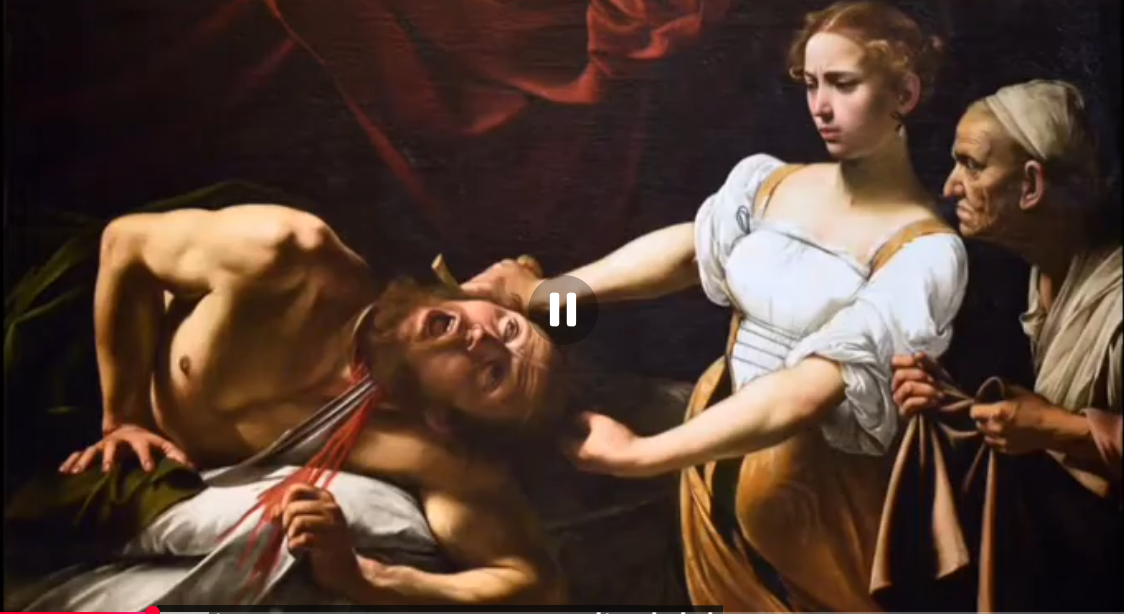
Above: screenshot shared from https://www.youtube.com/watch?v=Fuf1RbbDSlA
The naive innocence of an overly young and impoverished Judith who, perhaps out of hunger, accepted the commission only to find herself lost and disgusted by the blood of the groaning and still-living Holofernes, exposes her—in Caravaggio's interpretation—to the search for a deceptive validation, which she can only seek from the sole prompter present: the helpless old maidservant who is in a rush to finish.
A red curtain, of perhaps dark velvet, falling from above with no apparent support, acts as a watershed between the victim and her persecutor: and the applause undoubtedly goes to the magnificent Holofernes-Caravaggio, a splendid precursor to that 'Grand Guignol' which enjoyed success in Paris for nearly a century. [3]
Called upon to represent that highly controversial biblical passage which entered the Catholic Bible only in the 4th century a.D. in the West—and as late as the 6th century in the East—and which was accepted by neither the Hebrew nor the Protestant Bible, Caravaggio interprets with rationality and realism the uncertain liberation of the Judean city of Bethulia from the siege laid by Holofernes. The Assyrian—meaning Persian—general was under the command of Nebuchadnezzar[4], and his defeat came by the hand of the beautiful, young, and wealthy widow Judith, to whom the salvific—but entirely implausible—role of scapegoat was attributed for a murder plotted elsewhere and by who knows whom: in the painting, Judith, bent by the weight of the iron, is caught holding the heavy scimitar which Caravaggio skillfully depicts, already stained with the blood of another, horrifying her almost like a young maidservant called into the kitchen to slaughter backyard animals for her very first time.
Marina Bilotta Membretti/ Cernusco sul Naviglio – January 17, 2020
TutorSalus.net – Freudian journalism
[1] ‘Judith and Holofernes’, exposed in Rome at Palazzo Barberini/ Gallerie Nazionali d’Arte antica, has been chosen by the psychoanalyst Giacomo B. Contri for the Symposium 2019-2020 ‘Potere e innocenza’/ ‘Studium Cartello’ association, Milan.
[2] Michelangelo Merisi, known as Caravaggio, was born in Milan on September 29, 1571, and died in Porto Ercole in 1610. His parents, originally from Caravaggio (Bergamo), moved to Milan where his father worked as a master in church building sites. Between the ages of 13 and 17, he worked in the workshop of Simone Peterzano (a pupil of Titian) and other masters, though not continuously and despite having a contract. He left Milan in 1592 and never returned. His painting, ultimately appreciated only in the 20th century, nevertheless created the ‘Caravaggism’ movement among his contemporaries and followers.
[3] ‘Grand Guignol’ is the name of a Paris theater (1897–1963) that staged bloody shows with scenes of cruelty, attended by enthusiastic crowds of spectators.
[4] Nebuchadnezzar, known as the ‘king of the Assyrians’ reigned between 605 and 562 b.C.
Logic Allies.
The foresight of thinking.
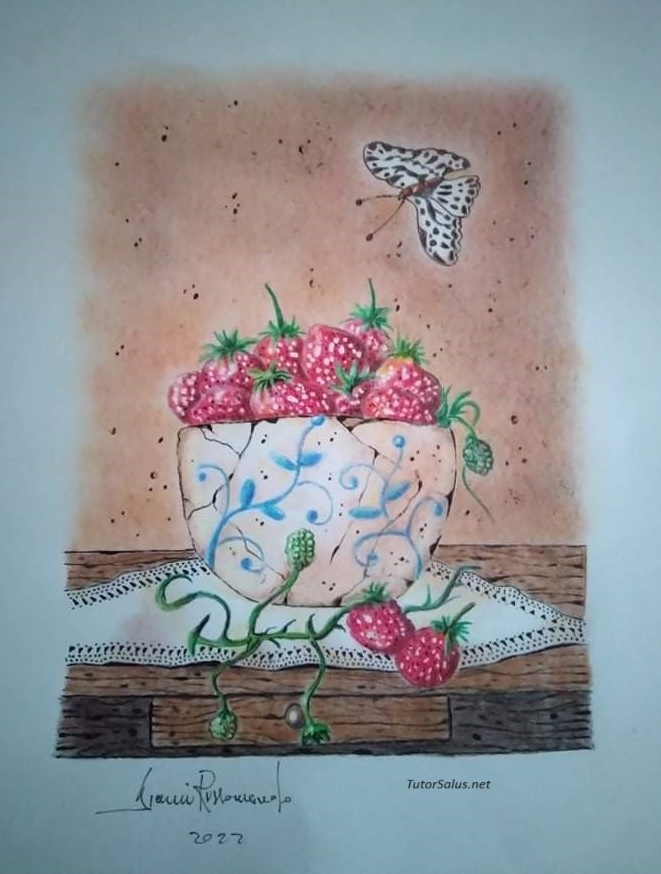
I know I have a special connexion for pink… Could this be why last October 28th at ‘Meet me tonight’[1] I chose the Laboratories of ‘Cultura e società’ as they were marked by the pink color ?
I specifically chose the ‘Behavioural Economics’ Laboratory which involved a points game, ‘GDPR – The Privacy Game’. Surprisingly I got top marks : the Researcher who had explained the rules of the game to me, so asked me : “How did you do it ?” I replied that I had used Freudian logic.
An unexpected conversation then ensued about economic policy variables and their reliability, which require continuous, elaborate and complex refinements : a memorable conversation indeed.
Because the reading of ‘Psychology of the masses’ and ‘The economic question of masochism’[2], although excluded from academic texts, can instead manage to arouse curiosity in the readers to take again that initial economic intuition, which unifies one’s thinking and which we normally encounter in a state of cultured specialization and fragmentation that didactics neglects as it is already involved in training the automatisms of the mathematical and econometric formulas.
An economic intuition has nothing to do with the mystique of istinct, which is programmable at your will, because every intuition evaluates the intellectual investment to use it, under penalty to lose the ‘goal’ that is individual at first, but with a far-sighted perspective.
Marina Bilotta Membretti / Cernusco sul Naviglio – October 1, 2019
TutorSalus.net - Freudian journalism
Original painting by Gianni Russomando.[3]
[1] The Project ‘The European night of Researchers in Italy‘ is included in the ‘Framework Programme on Research and Innovation‘ Horizon 2020, MSCA ‘Marie Sklodowska - Curie Actions‘ grant agreement N°818910. At Milan ‘Meet me tonight – Face to face with Research‘ (October 27-28, 2019) participated ‘Politecnico di Milano‘, ‘Università degli Studi di Milano‘, ‘Università di Milano-Bicocca‘// www.meetmetonight.it
[2] ‘Beyond the principle of pleasure‘ (1920), ‘Psichology of the masses and analysis of ‘I’’ (1921), ‘The economic question of masochism’ (1923) are some famous works by Sigmund Freud involved in economic disciplines.
[3] Gianni Russomando, short biography : “I’m born in Vercelli (1956), graduated at the ‘Istituto di Belle Arti di Vercelli’, I describe myself as an ‘amanuense’ (medieval hand-painter) and far from expositions and competitions.”
Stumbling block.
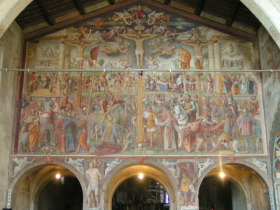
In the picture the great partition wall of 1529, fairly considered the most famous Renaissance fresco of Swiss, a work not just given by Bernardino Luini, but to him commissioned and paid as his own payment receipts to the Sponsors can document.
It is about the rising again : a human experience, then an unavoidable thought, ascribable indeed to an added value and to a further profit. However it is easily rejected… The Sun rises without any work, (that is, it cannot resurrect).
I was thinking about the above, when I was in front of the complicated fresco made by the great master Bernardino Luini, excellent disciple of Leonardo Da’ Vinci and here in his professional maturity making him a demanded teacher throughout Lombardy, Piemonte and up to the Swiss Canton Ticino.
We are in ‘Santa Maria degli Angioli’, charming and simple Romanesque church, standing just a little back on the Lugano lake-front : what visitor would you ever expect, coming to this largest partition wall, about one hundred ten square meters and richly painted, without any visual pause on which a lively city is described, with garnished horses and elegant knights, armed guards and mothers with children, passers-by and common men and women, merchants busying, notaries and shopkeepers while bustling about their daily and provincial jobs ?
If it weren’t for those refined spears, pointed at the three men on the Cross, half-naked and grieving but up there where any glance can’t get. Who ever infact would like to be in their place?
The heresy therefore is winding and winking, indulgent however among the Observants, minor friars coming from Milan, who around 1473 were well received at Lugano due to their work of pacification accomplished among the opposite city factions of Guelphs and Ghibellines, and to their own assistance to plague patients : the convent was founded in 1490 and the first stone of the church was placed in 1499.
Loyal to the ‘Bernardinian module’ which had single nave churches equipped with a partition wall high to the ceiling in order to separate the area reserved for religious, the believers of Lugano were coming here and got Eucharist, but they were assailed by dark sermons and nihilism. Resurrection was an uncomfortable item indeed, in these churches and we find it just allocated into a little corner, upwards on the right side of the fresco, like into a cupboard under lock and key.
In brief, on that enormous and colourful blackboard, the ‘lectio’ clearly says to the assembly to deal with what everyone is entitled to on Earth, so dodging the divine punishment but, on the other hand, thanking the Sponsors, who renewed in 1496 that agreement in remembrance of the peace already drawn up in 1445 among the factions of Lugano, to get an earthly Power in the name of God.
The title for the fresco is ‘Passion and Crucifixion’, where Jesus is diminished to just one of the three men and the ‘imitatio Christi’ – spoken ironically indeed – can’t be a human ambition, but only a leaden servant premonition.
It is too early for that Council in Trento which in the second half of ‘500 had to recall the strength of Carlo Borromeo Cardinal and Bishop of Milan, maybe the only one protagonist, in order to put out the greediness of heresies culminated in the Schism of the Protestant reform ?
Engaged without any energy saving on such a vast field, that saint and also so torn man could at least indicate, by his own humanity, that resurrecting is then possible.
Neverthless, without any delegation.
Marina Bilotta Membretti / Cernusco sul Naviglio – August 5, 2019