

Excellent notes of economic thinking taken from analytical work.
Strawberries
Audience?
Robert Carsen[1] direction for the Teatro alla Scala of Milan.

Screenshot shared by https://www.youtube.com/watch?v=nDXQuow_yT4/ ‘Così fan tutte, ossia La Scuola degli Amanti’, by Wolfgang Amedeus Mozart (1790). Librettist Lorenzo Da Ponte. Direction 2025 by Robert Carsen for the Teatro alla Scala of Milan. Conductor Alexander Soddy[2]. Orchestra and Choir of the Teatro alla Scala.
It would certainly be surprising if Mozart[3] talent—unquestionable and rare—could entangle in a melencholy to that powerless frenzy that generates 'audience'. Yet, the direction by Robert Carsen has been able to grasp the double tone behind which Mozart concealed his deep thinking.
Mozart died too soon, in the year following the première of ‘Così fan tutte, ossia La Scuola degli Amanti’, where doubt and naivety can deceive those who accept only words, and sometimes even wound them unto death. The music, however—the same music which Mozart knew how much it can stun, enchant, and even strip away one’s own authority—also moves on an inner ground, his deep thinking: his conflicted but not defeated psychology. The listener cannot fail to grasp this dialogic distance, which renders the philosopher’s Wisdom cynical and Despina’ Malice obtuse.
Deception—which here becomes the protagonist—is always a ‘dramma giocoso’ that, even technically, finds here a rotating stage around which it agitates the audience made contemporary to a reality show, because it barges in and sweeps through social media, deviating and corrupting both its function and functionality: an audience as greedy and impatient as those in a late 18th-century ‘Sala di caffè’, but inclusive here of technicians and workers who honestly find occupation and employment therein.
Deception is also a cruel drama, of real relationships and affections that will find it difficult to defend themselves when the offense[4] strikes, because clamor and emotions are a frantic, adulterated vortex, indispensable for the passage of any deceit.
There is indeed a temptation by Mozart—which the librettist endeavored to exasperate, but without gaining his assent (this is what interests us most) - because at those very same days Mozart himself was writing a heartfelt, powerful letter[5] to his own wife Constanze.
And it is precisely in reproaching - but with an elegance, respect, and gratitude that make Robert Carsen one of the most valid defenders of the great Austrian composer - the temptation Mozart resisted, that the Canadian director - who preferred Europe - even offers himself as an ally as he succeeds in bringing to judgement those who, for fame or money, manipulate for fun their own affections and relationships, in an euphoria of pure and atrocious visibility: Carson reminds us—thanks to his multifaceted experience—that even ancient Greek Tragedies[6] still are capable of being listened to a lot today.
The orchestra is —though half-hidden to the spectators, in the understage or hyposcenium where they work – the true relationship of loyalty between the conductor and the musicians[7] which founds, and here maintains, Mozart's deep thinking: this orchestra lead to the emergence of a judgement that recognizes naivety - the one of others and therefore one's own—as the gateway to deception, always a harbinger of pain and mourning. A judgement which is unimaginable and yet possible for someone who - maybe as Mozart himself did - had already erred in the life, and could not honestly become cynical now, nor moralistic. To whom, then, will the applause go?
A maître and a maîtresse are necessary to compose the deception that defrauds and robs, with the indispensable support of ever-ready collaborators. But what is the cost of the pain that deception always prepares?
Because here, through music alone, Mozart communicates to us that pain consumes and is consumed like Finance without Economy, and like a totem that does not allows for work but rather despises it: one falls into error, Mozart suggests to us, with a clarity and humility that gives you chills.
Carsen - it is his incomparable talent in this direction - finally entrusts the real audience present in the Theater with that 'destiny' - which is perhaps more of a 'duty'[8]—to applaud the successful deception, thus rewarding, once more - and in full 'conscience' - the declared unreliability and the enacted manipulation. A cascade of glittering coins descends upon both deceived and deceivers, like a light and weightless rain, even pleasant: but which the fading of the lights renders dilapidated, ephemeral. Music, as we know, reaches one’s thinking so directly to even lower psychical defenses.
Yet Mozart also entrusts to 'his' music the unequivocal power of a ‘Psychisches Geschehen’[9], which is always unexpected and equally real, but not looking for audience.
Marina Bilotta Membretti/ Cernusco sul Naviglio - January 8, 2026
TutorSalus.net - Freudian journalism
[1] Robert Carsen was born in Toronto (Canada) in 1954 and since he was a child he demonstrated a great passion for theatre: so he began studying acting, but at 20 years old he moved to England to continue his studies in directing, getting his first job as an assistant director at the Festival of Spoleto (Italy) and in the same time at the Royal Opera House of London, which allowed him to collaborate for a long time with the prestigious Glyndebourne Festival Opera; already engaged as an assistant director for the Canadian Opera Company, he stood out as a set designer in 1987 with the National Ballet Canada at the Grand Théâtre de Genève; among his best works we remember: ‘The Nibelung’s Ring’ at Cologne, ‘Eugene Onegin’ at the Metropolitan Opera, ‘La Traviata’ at the Theatre ‘La Fenice’ of Venice, ‘Mephistopheles’ at the San Francisco Opera, ‘Rusalka’ at the Opéra Bastille of Paris, ‘The Knight of the Rose’ at Salzburg Festival; in Germany he directed many works by G. Puccini and G. Verdi until he began a collaboration with the Teatro alla Scala of Milan which still continues; in 2001 he directed the musical ‘Sunset Boulevard’; at the Greek Theatre of Siracusa (Italy) he directed ‘Oedipus Rex’ (2022) and ‘Oedipus at Colonus’ (2025) by Sophocles; he received many awards and was honoured with the Order of the Legion of Honour (France, 1996) and with the Order of Canada (2006).
[2] Alexander Soddy (1982, Oxford) : trained at the ‘Royal Academy of Music’ of London, he is now conductor at the ‘Nationaltheater Mannheim’ since 2016-2017 season. He debuted in the 2008-2009 season with ‘The Magic Flute’ by Mozart for the Staatsoper of Hamburg, of which then he became also ‘Kapellmeister’ from 2010 to 2012.
[3] Wolfgang Amedeus Mozart (1756 – 1791) is perhaps the greatest composer of music in the world – and musician and conductor he himself – with a very rich, original and refined production, of exceptional value. Mozart grew up in the assiduous cultivation of music, but he also demonstrated at a very early age an uncommon talent and musical memory. He extensively traveled in Europe since he was a child with his family, costantly seeking new commissions, which were undoubtedly vital for a musician at that time, but that slowed down his father’s professional career, who was already assistant to the musical director at the court of the Prince Archbishop of Salzburg. In 1762, before he was six years old, the child Mozart performed in an official concert for the Bavarian Prince and his court; then in 1763 he was been traveling for more than three years; in 1767 he traveled for a year and a half; he was in Italy for three times between 1769 and 1773, stopping in Milan first in 1770 – when he stayed in the rectory of the church of Saint Mark – then in 1771, then again in 1772. Between 1777 and 1779 he traveled with his mother who died in Paris in 1778, also as a result of lack of adequate care. Even abroad, Mozart received meager compensations from his clients, notwithstanding the incredibly high standard and the undeniable success of his work. In 1781 after a formal disagreement with the Prince Archbishop of Salzburg, for whom Wolfgang had worked at his court as ‘first violin’, and as an ‘organist’ - never as a ‘composer’ - after the trip to Paris, Mozart submitted his resignation which was received with open hostility. From that moment he lived in Wien, where in 1781 married Constanze, with whom he had only two children who survived to adulthood, and where he found a fair economic fortune until 1786, thanks to commissions for piano and orchestra concertoes, while he continued to produce operas. With the 1786 public première of ‘The marriage of Figaro’, first ‘dramma giocoso’ which contained also a clear social criticism, Mozart froze a part of his clients who preferred more common and obsequious composers to him: despite the work enjoyed vast success abroad, leading even to the definitive evolution of the so called ‘opera buffa’, that Mozart brought to an unsurpassed level of importance, because this theatrical form allowed him to simultaneously combine dramatic effectiveness, psychological introspection, and the seamless integration of text and music. In 1787, the première of ‘Il dissoluto punito, ossia il Don Giovanni’ was held successfully in Prague; however, Vienna did not bestow the same honors upon Mozart. Consequently, in 1789, he set out on a long journey through Germany, once again in search of new commissions. In 1790, he presented the ‘dramma giocoso’ ‘Così fan tutte, ossia La Scuola degli Amanti’ in Vienna, and the opera was successfully performed nine times that year. At the same time, however, he declined a generous offer from a British impresario for an interesting position as a composer that had finally been offered to Mozart. In 1791, he successfully presented ‘The Magic Flute’, which was performed hundreds of times in the years to come, while Mozart delayed dedicating himself to the ‘Requiem’ he had just begun, and this work remained unfinished at the time of his death in December of that same year.
[4] “Soave sia il vento, tranquilla sia l’onda…”/ Act I, scene 6°; “Umiliato, schernito… dal perfido cor”/ Act II, scene 9°.
[5] Cfr the letter by Mozart to his wife Constanze (August 1789) cited by H.C. Robbins Landon in ‘Mozart. Gli anni d’oro 1781 – 1791’, Garzanti 1989.
[6] Cfr https://www.youtube.com/watch?v=nDXQuow_yT4
[7] Cfr https://www.youtube.com/watch?v=lfA_QWdedio
[8] “ove il destino, no: il dovere v’invita”/ Act I, scene 5°.
[9] Cited in ‘Inherit from a child. Why not ?’ Chapt.3, pg.77/ 'Suggestibility' - which Freud dealt with in 'Psicologia delle masse e analisi dell'Io' (1921) - poses a fork vs 'psychic occurrence' ('L'Io e l'Es' - S. Freud 1922 in OSF Bollati Boringhieri pages 482-490).
It’s simple/ 8.
A pain supported by conscience : stuttering.

“Stutter is a symptom of neurosis, then defensive, a good defense: the child does not want to tell a lie and stops, he - or she - omits to say what he, or she, did not want to say.” [1]
Stutter is pain – euphemistically a disability – and starting from child: conscience fuels this pain.
Marina Bilotta Membretti/ Cernusco sul Naviglio – December 3, 2025
TutorSalus.net - Freudian journalism
[1] Cited from the Prolusion by Giacomo B. Contri, October 13, 2018 to the Symposium ‘Quid amor ?’ organized by ‘Società Amici del Pensiero – Sigmund Freud’, Milan.
It’s simple/ 7.
Resistance and duty.
“A lapsus, more simply, offers one’s thinking as a legislator: ‘I had to say a person’s name, and I pronounced another’s name!’… He, or she, had removed his own, or her own, thinking and this resurfaces in the lapsus: how powerful the unconscious is! …But you can deny your lapsus, which is the ‘first’ as preceding my intention: the temptation is to become independent from one’s own thinking… or rather cancel thinking.” [1]
“Resistance to one’s own individual competence, as a legal capacity to modify reality with respect to the principle of pleasure, makes no effective defense possible.” [2]
This is not a mistake: in a lapsus your thinking understood well enlightening profitfully the conscience which, having done one’s own duty, would not know what else to do.
Marina Bilotta Membretti / Cernusco sul Naviglio – August 3, 2025
TutorSalus.net - Freudian journalism
[1] Cited from ‘Prolusione’ by Giacomo B. Contri – October 7, 2017 Symposium ‘La prima costituzione’, organized by ‘Società Amici del Pensiero Sigmund Freud’, Milan.
[2] Cited from p. 38 ‘Inherit from a child. Why not ?’, Marina Bilotta Membretti (2024) Preface by Luciana La Stella - Postface by Giuseppe Oreste Pozzi / NeP edizioni Srls - Rome. See also ‘Precisazioni sui due principi dell’accadere psichico’, S. Freud (1911) OSF Bollati Boringhieri, Vol. 6
…but it’s not the same thing.
EU AI Act and more.
“According to the EU AI Act, an 'Artificial Intelligence system' is defined as a machine-based system designed to operate with varying levels of autonomy. [1] It may exhibit adaptiveness[2] after deployment and, for explicit or implicit objectives, infers from the input it receives to generate outputs such as predictions, content, recommendations, or decisions that can influence physical or virtual environments.” [3]
Already in the late ‘40s the French photographer Robert Doisneau described a phenomenon that he wanted to call ‘optical unconscious’, a term which then slipped away but also which prompted him a lot. He realized in fact that what the photographer was sure having captured didn’t coincide exactly with what the camera lens had photographed: he also noticed that the product could be even different from the photographer intention, whose subjective and real vision allows him, or her, to then produce photography.
Machines have no unconscious, however they are able to generate contents even independent of their design: probably for the first time in the whole sphere of a legislation, the recent ‘EU AI Act’[4] intends “setting a global standard for AI regulation” as a factor of results which are ‘not neutral’, that is, not irrelevant on citizens and society.
However, unconscious is the only one able to grasp the quality of an algorithm: an activity which conscience is not equipped with.
Marina Bilotta Membretti/ Cernusco sul Naviglio – July 7, 2025
TutorSalus.net - Freudian journalism
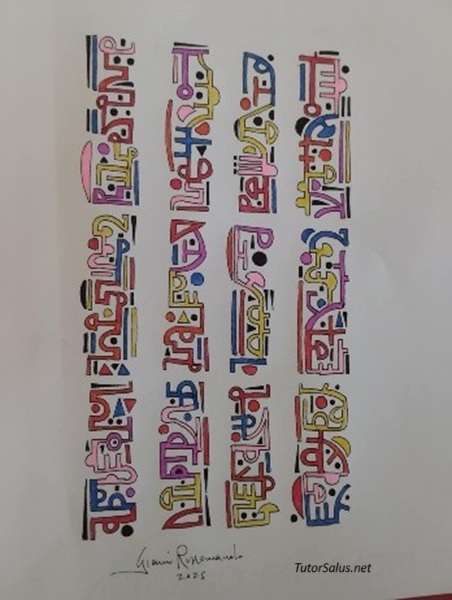
Original painting by Gianni Russomando.[5]
[1] That is, ‘operates with some degree of independence from direct human control’.
[2] In fact, ‘it may evolve or learn post-deployment (self-learning, model updates)’.
[3] https://www.modulos.ai/eu-ai-act
[4] Entered into force on August 2nd, 2024 the EU AI Act – which integrates the current regulation GDPR General Data Protection Regulation – will be implemented gradually by 2026 in the sphere of high-risk content, and specifically aiming at providers of AI generative of content.
[5] Gianni Russomando: “born in Vercelli (1956), graduated at the ‘Istituto di Belle Arti di Vercelli’, I can describe me as an ‘amanuense’ (medieval hand-painter), far from expositions and competitions.”