

Partner of thinking, and lack. Training as a psychoanalyst.
Thinking as a partner
“Persepolis”.
From ‘souff(e)rance’ a ‘douleur’ ??
In an excellent ‘Séminaire’[1] by Jacques Lacan, the famous Parisian psychoanalyst and passionate follower of Freud pointed out a clever game of the unconscious. He showed how the absence or presence of a single letter in a word can bring together or keep apart two meanings that do not exactly resemble each other. The word in question was ‘souffrance’, which the French language translates as 'transit' or 'storage', commonly used in postal services and correspondence.
However, the simple inserting an 'e', changes everything: et voilà! That word becomes soufferance, a suspended tension waiting for a solution, which effectively describes what Freud meant by 'urge'.
Therefore, soufferance would not have a pre-judged destiny toward la douleur (i.e. ‘pain’). if it maintains the quality of ‘souffrance’ - that is, of a 'temporary' storage, a 'transit' in the processing of a satisfactory solution. This solution cannot logically be melancholic or narcissistic as well, even though it often results in being socially compassionate, causing an 'emerging damage'[2].
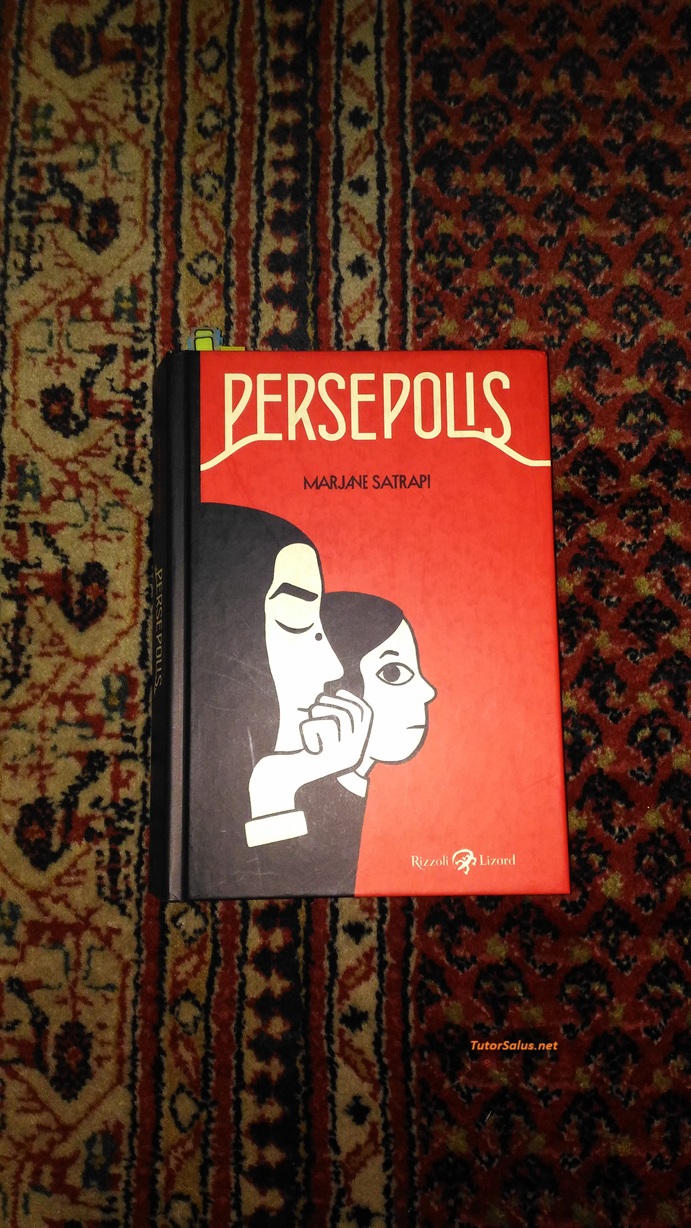
I find myself, then, sincerely thanking Marjane Satrapi for her remarkable ‘Persepolis’[3], a ‘first’ work written in the first person for the 'first' Iranian graphic novel. The simple drawings are deeply expressive and beautifully set, while the prose is effective and, above all, uncompromising.
The surprising cover already reveals something of a powerful message. In the foreground is the profile of a young woman with closed eyes and a large mole on the side of her nose. In the background, a little girl looks at the reader with wide-open eyes, lacking that mole which Marjane explains appeared precisely during her transformation from an adolescent into a woman, alongside a significant growth in height.
Marjane Satrapi says very little about the choice of the title, ‘Persepolis’, dedicating a rather obscure chapter and just a few scattered hints throughout the narrative to it. Translated from ancient Greek, Persepolis simply means 'city of Persia.' However, it was the second of the five ancient capitals following Pasargadae (and alongside Babylon, Susa, and Ecbatana). It was founded around 515 b.C., 1700 meters above the level of the sea, and about fifty kilometers north of the modern city of Shiraz in the Fars province of Iran.
The history of Persepolis, which Darius turned into the splendid capital of Persia with palaces and terraces, is linked to the mythical 'Jamshid the Radiant.' In the ancient Avestan language, Jam-Shid results from the union of two names and is today a widespread male name. He gives the name 'Throne of Jamshid' to the site where the magnificent remains of Persepolis still stand. Zoroastrian writings state that he was the ruler of an ancient dynasty who received a ring to seal and an inlaid dagger, both of gold, from the 'Omniscient Creator' to bring His law to Earth. One could say that in this mythology, the alliance—even a marital one—with the human, patiently sought by the 'Omniscient Creator,' exists exclusively thanks to an intelligent capacity for 'work' that characterizes men and women on Earth.
"In Greek mythology, heroes are predestined, whereas in 'our' myth, the concept of 'fate' does not exist...", explains the Iranian scholar interviewed by Marjane[4] in the book when she was working with her husband Reza on a project commissioned by the University of Tehran.
As the pages of ‘Persepolis’ turn, the choice of that title finds validation in Marjane’s vicissitudes. She begins with a protected childhood where, as the daughter of progressive, wealthy parents of noble origin, she discovers the dark spots of an ancient, complex, and self-referential culture. Is it normal, ten-year-old Marjane wonders, to blame children for the sins of their fathers? Is it normal to be served at home by a peer because she was sold by 'poor' parents as a family maid? Is it normal to accept that belonging to a social class is socially discriminatory? Marjane considers herself "...born with religion" and as a child often finds herself talking directly to God, "...sure of being the last of the prophets." [5] The resemblance to 'The Radiant' is truly striking.
Then come the years of the Khomeinist dictatorship with its fierce repressions and limitations. If her parents opposed the Shah[6], they cannot support a fundamentalist culture that forbids any initiative and individuality, leading them to decide what other families were already doing: sending their children abroad. In 1984, Marjane leaves for Vienna, where she stays for four years, completing the studies that would have been forbidden to her in Iran, but meeting peers, families, and institutions for which she is unprepared, despite being intelligent and cultured. "I pretended to join in, but I didn't inhale the smoke...", "...then I simulated wild laughter, I was quite credible", "I even went so far as to deny my nationality." [7]
Returning to Iran, she finds the country's repressive atmosphere even more suffocating. Yet, with great determination, she decides: "From today on, I want to change my life..." She meets Reza, with whom she prepares for and passes the 'National Exam' required for the admission to University. One day in the city, to avoid one of the frequent checkpoints of the 'Guardians of the Revolution,' Marjane falsely accuses an innocent bystander of harassment, leading to his arrest. However, she admits that due to the regime, 'public conduct' and 'private conduct' were poles apart. [8]
She then decides to marry Reza, but recalls that by the time she found herself in their marital apartment, she already 'regretted' it.[9] Perhaps for this reason—and despite his lucidity in admitting the 'social pressures' capable of cracking a relationship[10]—she decides to divorce three years later and move to France. There, at twenty-six, she begins her promising career as a cartoonist, precisely thanks to the success of ‘Persepolis’—an engaging, limpid narrative without conclusions about a resistance to the 'new,' in front of which cultural archetypes remain a wall for those who use them.
Marjane admits in the final pages[11] that "When problems are no longer acceptable, the only way to bear the unbearable is to laugh at it..."
But 'work' is either conclusive, or it is nothing. Laughing at it—meaning trivializing it—sounds like a jarring contradiction to that splendid, yet marble ‘Persepolis’, historically founded to seal the divine question to humanity throughout the centuries.
Marina Bilotta Membretti/ Cernusco sul Naviglio – May 1, 2020
TutorSalus.net – Freudian journalism
[1] “Il seminario su ‘La lettera rubata’” in “Jacques Lacan. Scritti” Vol. I edited by Giacomo B.Contri, ‘Giulio Einaudi editore SpA’ 2002 / pagg.27-30
[2] ‘Emerging damage’ together with ‘ceasing profit’ and ‘not emerging profit’, is one of the three configurations of the psychopathological diseconomy in “Un uomo che ha domani”, by Giacomo B. Contri / pag.19, see ‘Opera omnia’ 2015 – ‘Sez. Saggi, testi pro-manuscripto’.
[3] ‘Persepolis’, by Marjane Satrapi/ ‘Rizzoli Lizard’ – Mondadori Libri SpA / 12° edition 2019 (original title ‘Persepolis. Histoire d’une femme insoumise’) was given to me by Laura Santalucia, Federica Membretti, Marco Membretti whom I especially thank for the work they have invited me to do with this substantial autobiography.
[4] ‘Persepolis’, cited p. 337
[5] ‘Persepolis’, cited p. 8
[6] Mohammad Reza Pahlevi was the last Shah of Persia until the Islamic Revolution of 1979 : he abandoned his Country and fled to Egypt where he found asylum.
[7] ‘Persepolis’, cited, p.198-201
[8] ‘Persepolis’, cited, pp.294-295, p.314
[9] ‘Persepolis’, cited, p.326
[10] ‘Persepolis’, cited, p. 347
[11] ‘Persepolis’, cited, p. 275
‘West awoke late in the East day’[1].
From “Mappamondo”, by Massimo Bucchi[2].
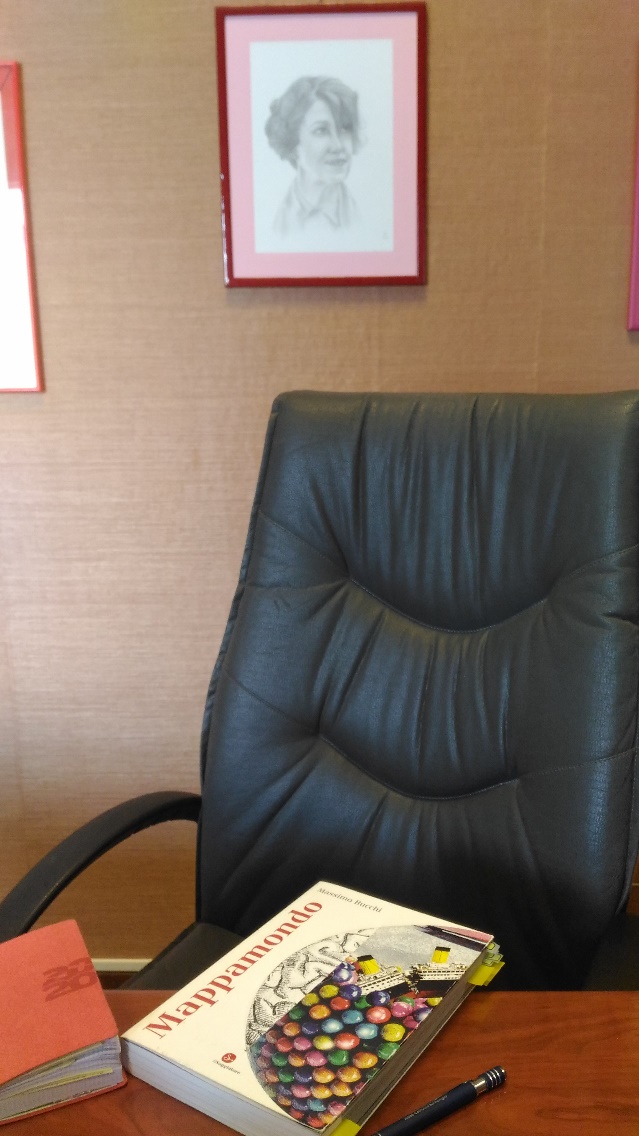
In the picture, my working copy in the Studio.
Dreaming is an alibi ?
In “Mappamondo” by Massimo Bucchi I’ve found that yes, dreaming is one’s own, very personal ‘map of the world’. Which however we better not remove when, awake, each of us tries to save oneself as best as one can from global pedagogism.
The comforting alibi of our dreams is surely a defense, but naive and then pregnable, except for a job that is not common at all, whose precious efficacy remains individual, that is not transferable to third parties.
‘West awoke late in the East day’ is a very nice aphorism coined by Massimo Bucchi, that got me thinking – in these weeks of pandemic isolations due the contagion from the unknown Coronavirus where East assured themselves a leading role : just like in our nocturnal dreams, the-totem-of-guard- is there, though completely asleep.
And describing it is possible – Massimo Bucchi confirms – but replacing it with a softer representation, otherwise our dream stops to be that wonderful world where we can take refuge to forget. Or from which we daily escape trivializing it upon waking, that is promoting it to an Ideal : because even the ‘soft’ representations can find us unprepared, but in the same time, and naively, arrogant.
In short : caring, or distracting oneself ? It is a crossroads for everyone, not avoidable.
How Massimo Bucchi came to conceive so precociously ‘West awoke late the East day’ we are not given to know, also because an artist usually stops looking for the reasons of his own thinking, in order to go on creating : and the creativity itself, which even requires talent and application, eludes verbalization that however never rejects a further, perhaps more fruitful, talking about.
Here we can observe having fun that an ancient compass is all that remains vital next to the monumental, sleeping stone lion, whose enormous paw released cannot cause fear, at least while he sleeps.
And this is how the finished work reaches the public, gratified with no work and no profit, whether it’s sculpture, music, or graphics : since satire is just one part of that universe – accessible to few – that remains humour, only human capacity to be able to sum up in very few words an innocent judgement which conscience doesn’t have time to gather, and it is immediately said.
‘Celui-qui-me-fait-guerRire’ is an aphorism of mine – no longer unconscious then - in recognizing Freud’ valuable insight about humour. So that, what is conscience then ?
That stable lump which discards laughter.
Marina Bilotta Membretti / Cernusco sul Naviglio - March 31, 2020
TutorSalus.net - Freudian journalism
I will resume April 13, Monday.
[1] It is the title for one of the sketches by Massimo Bucchi as published in the collection “Mappamondo”, 2016 / Publish.: “il Saggiatore”.
[2] Massimo Bucchi was born in Rome in 1941. He started as a reporter of crime news, and then dedicated himself to graphics as an ‘art director’. His passion for humour, cultivated since he was a boy will lead him to invest his talent in different and prestigious collaborations to which he is gradually called, and also in the film industry : his contributions of many years for “la Repubblica” certainly stand out, in addition to many awards received. He also cared interesting exhibitions of his own works.
Why is it so horrifying ?
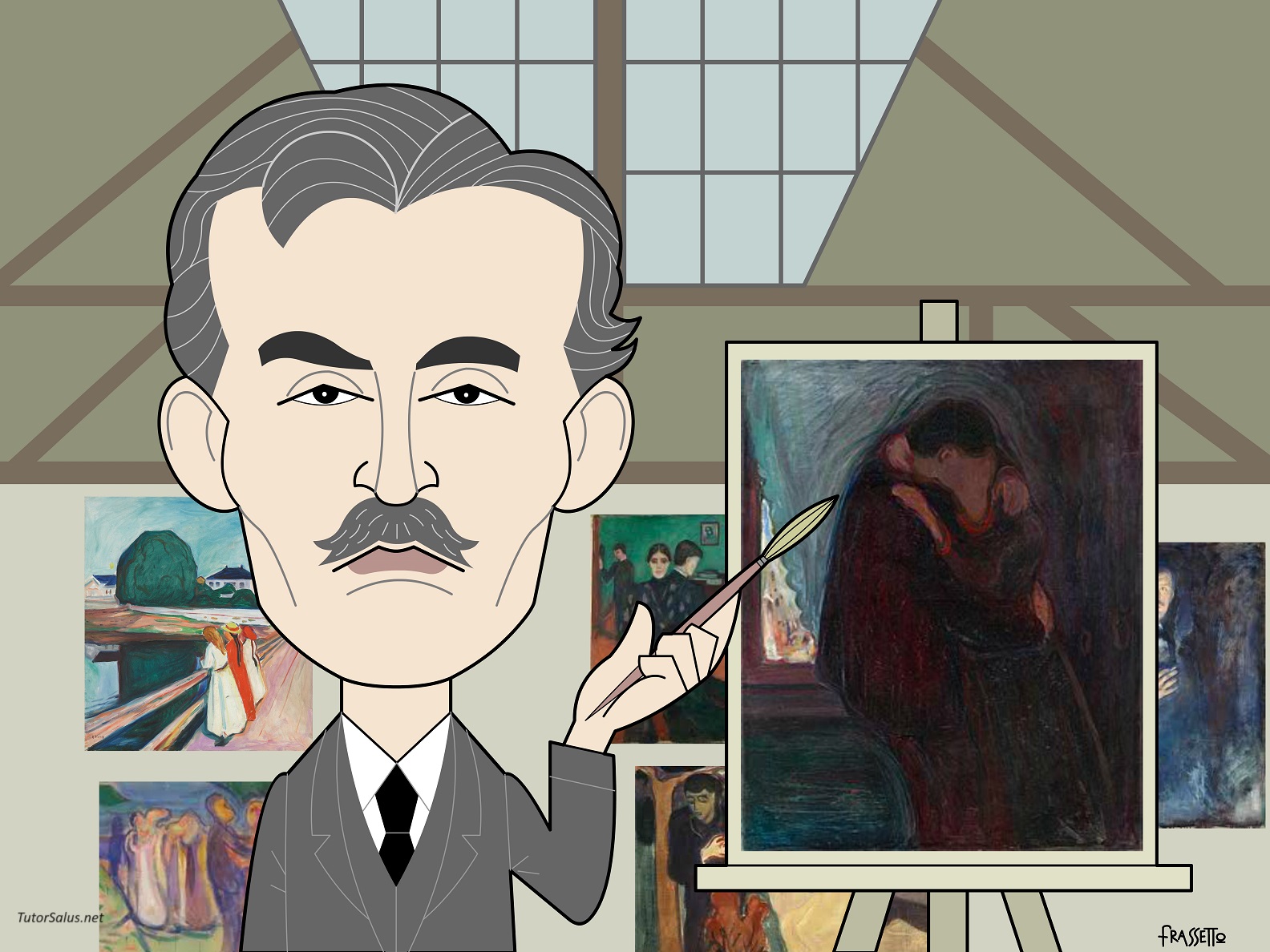
Original painting by Stefano Frassetto (6).
“Why is it so horrifying the idea that removing is an experience of lying ?” (1)“
Maybe is still correct the above quotation by Giacomo B. Contri about a common experience, the anguish : about which we come to know very soon, already in early childhood, and towards which an initial, but disadvantageous defense is the removal of the experience given rise by anguish.
The exceptional talent of Edvar Munch in painting, and of only a few painters indeed (2), surely is in being able – that is infact the power of thinking – to go up again the origin of one’s anguish, untieing it up to weave a more profitable defense instead of the removal itself.
“I was walking along the road with two friends when the sun was setting, the sky suddenly coloured in blood red. I stopped, and really tired I leaned against a fence. On the black-blue fjord and on my own town there were blood and tongues of fire. My friends kept on trembling, and me too was still trembling with fear… And I was feeling that a big scream was pervading the nature…” (3)
In the shape of a visual hallucination which turns away the reality, Munch was describing in a note from his diary the experience of the ‘return of a removed memory’, the feared and hard-fought satisfaction, unsustainable indeed… The removal, as a matter of facts, still remains irresolute also if practiced, even it does menace a subject and his, or her own physical integrity too.
The 1893 painting belongs to the maturity of Munch who had already developed a competence not only in painting but also in his own relation with it. He sensed in painting, to which he applied himself by chance, a privileged and very personal way, but definitely alternative, to anguish. At school he had realized he could excel in psysics, chemistry and mathematics and chose to specialize at the ‘Drawing School‘ of Oslo, and then at the ‘School of Arts and Crafts‘ of Christiania in 1881 : but it was maybe only when Munch met Hans Jaeger (4), a not excellent writer and even psychologically disturbed in comparison with the reserved and discreet Edvar, that the writer did kick-start again a favourable, personal intuition into Munch’ thinking.
That was infact a real change of course for the painter and not at all ephemeral towards a sincerity he hadn’t known before, which approached him to the very reason of his past submissions, and also pointed out easily and precisely the point where he could correct his mistakes, and his ingenuity too that now became corrigible then : into Munch’ work, into his many repetitions of the same few pictures - not just ‘The scream‘, as a matter of facts - is therefore evident that his own deep interest was not the approval by the public.
There isn’t any pedagogical aim infact in his works, any attempt ‘to explain’ to the spectator, who could imagine everything when being in front of one of his pictures. Munch’ evident goal is to get to touch the tangle he himself was living in order to untie it, without any uncertainty and without any doubt.
Anguish flows into horror when it is not processed, Munch had seen such epilogues among his own relatives too, and had realized that it couldn’t be due to a motionless fate.
With the surprising lucidity of a surgeon, he could be building a very personal and favourable path of work, not to be reproduced but for its peculiar practicability.
Marina Bilotta Membretti / Cernusco sul Naviglio – October 26, 2019
(1) ‘Lavoro dell’inconscio e lavoro psicoanalitico‘, by Giacomo B. Contri, 1985 SIC Edizioni.
(2) I’m going to dedicate an editorial to Renè Magritte, Belgian painter lived between 1898 and 1967 and considered one of the best interpreter of Surrealism.
(3) This is a memory, which Edvar Munch (Loten, Norway 1863 – Oslo 1944) managed to bring back on the frame of one of the four versions of ‘The scream’, the one of 1895. “The scream” (1893) is a work exhibited at the ‘National Gallery’ of Oslo.
(5) Hans Jaeger (1854-1910), wrote “Between Kristiania and Bohemen“ (1885) and became famous due to his raw controversies against the Norwegian culture rather than to his real value as an author and writer.
(6) Stefano Frassetto is born in Turin in 1968. After his degree in Architecture at ‘Politecnico’ he begun as graphic novelist for local magazines. In the ‘90s he edited in France too, on ‘Le Réverbère’ and on ‘Libération’ : then he created ‘Ippo’ for ‘Il Giornalino’ and then the stripe ‘35MQ’ for the swiss magazine ‘20 Minuti’. In 2000 he came into ‘La Stampa’ as portraitist for cultural page and the insert ‘Tuttolibri’, then for the weekly ‘Origami’. Today he works also for the swiss magazine ‘Le Temps’.
Psychoanalyst and profession[1].
To benefit from one’s calling/1.
”Psychoanalysis… is certainly not the whole psychology, however that is its essential structure, maybe even its fundamental… Then any analyst must have learned, first of all, that psychology, or depth psychology, or even better the psychology of the unconscious.”[2]
“…After fortyone years of activity, the knowledge I got of myself tells me that I have never actually been a doctor. I’ve become a doctor having been forced to turn away from my original purposes, and the success in my life is in finding again indeed, after a tortuous very long deviation, the guidance of my own beginning…”[3]
We see that Freud was getting late to his own calling, in his maturity : and he realized it was already a profession, but original and new, that is never started before.
“…The aim for us analysts is making an analysis as complete and in-depth as possible together with our patient, whom we don’t like to bring relief welcoming him, or her, into a community, be it Catholic or Protestant or Socialist; instead what we like to do is enriching him, or her and get that richness from his or her own unconscious just making flow to his, or her ‘I’, both the hidden and therefore unapproachable energies due to the removal, and any further energy the ‘I’ is forced to waste without any fruit…”[4]
Freud effectively tells about psychoanalysis in economical terms : en enrichment which the removal makes unapproachable to the patient who, on the opposite, dissipates many energies just to keep an ineffective defense from the removal. Less than fifty years later, Jacques Lacan welcomes Freud.
“…And, about richness, why not starting indeed from the rich ? The rich owns a property. He buys, he buys eveything, eh! We can say that he buys a lot. However… the rich doesn’t pay…
First of all, we know very well that the surplus he everytime adds to himself, or herself… But, mainly, there is something he, or she, never pays for – the knowledge… The rich is no more a master, if not because he redeemed himself, or herself…
Since he is enriching himself, why he can buy everything without paying for it ? Because he, or she has nothing to do with enjoyment… Such knowledge the rich can buy as a surplus. But he just doesn’t pay for it…”[5]
Then the knowledge from psychoanalysis is a surplus, a benefit and a profit then, not just an enjoyment : Freud named ‘the benefit’ in his special work “Beyond the principle of pleasure”[6] as something profitable, quite different from the removal.
“The theory of removal is then the pillar on which the building of psychoanalysis does stands. It is the most essential element of psychoanalysis and it is nothing but the theoretic expression of a repeatable experience at will, if you proceed the analytical work with a neurotic patient without any hypnosis… It happens there to feel his, or her own resistance opposing to the analytical work and giving as a pretext the failure of memory, unfortunately with the aim of making it unuseful.
Hypnosis is hiding any resistance; so that we can say that psychoanalysis begins only with the technical innovation of giving up of hypnosis.”[7]
After attending, since 1886, the university lessons of Jean Martin Charcot in which, as in any future ‘direct’ therapy the work of the patient is not essential and his or her own guidance in the care too, Freud did favour the analytical work as it could be conducted by the patient only using his, or her own memory in the presence of the analyst.
“…The theoretic judgement if the resistance agrees with an amnesia, is leading inevitably us to conceive an unconscious psychic activity which is owned by psychoanalysis itself, and anyhow it is quite different from any philosophic speculations of unconscious.”[8]
Here it is why the conflict of interest between doctor and patient, not charging with the analytical work, can be on the other hand an obstacle in any said ‘direct’ therapy.
Marina Bilotta Membretti - Cernusco sul Naviglio, October 1 2019
[1] ‘Il progresso in psicoanalisi’, Morris N. Eagle in ‘Psicoterapia e scienze umane’, Franco Angeli editore – Anno 2018, Vol.52, n.3
[2] S. Freud, , “Il problema dell’analisi condotta da non medici. Conversazione con un interlocutore imparziale”, 1925 : you can wonder how rarely they draw from that specific work by Freud.
[3] S. Freud, ibidem
[4] S. Freud, ibidem
[5] J.Lacan, “Il seminario – Libro XVII, Il rovescio della psicoanalisi 1969-1970” with an afterword by Jacques-Alain Miller – Giulio Einaudi editore SpA 2001 / “Le seminaire de Jacques Lacan, Livre XVII. L’envers de la psychanalyse” 1991 Edition du Seuil, Paris
[6] S.Freud, “Aldilà del principio di piacere” 1920, Bollati Boringhieri Vol.9 p.242 : “…that the benefit from the amphimixes has been then picked up and used in the following evolution”.
[7] S. Freud, , “The item of the analysis conducted by not doctors. Conversation with a fair interlocutor”, 1925.
[8] S.Freud, “For a history of the Psychoanalytical Movement”, 1914.