

Partner of thinking, and lack. Training as a psychoanalyst.
Thinking as a partner
'The kiss' by Picasso.
Outism[1], or...?
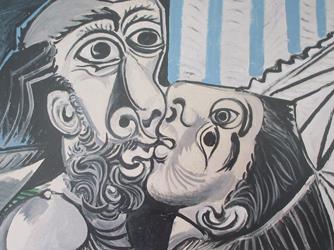
The above screenshot has been taken from ‘The kiss’, P. Picasso[2] (1969), at ‘Metamorfosi’ exposition - Palazzo Reale, Milan (October 18, 2018 – February 17, 2019)
'The Kiss' welcomes the visitor with a calculated vehemence, a programmed effect-driven aggression where the glassiness of the whites of the eyes and the animalistic quality of the wide-open eyes must prevail, along with the almost palpable relief of the sharp outlines, the agitated and uncontrollable gesture, the jarring colors: a hypnotic effect that has enchanted, until today, half a century of admirers all over the world.
In 1969[3], therefore, the passion for Picasso was already a matter of achievement and supremacy, a bullfight between two bulls and no humans, the hallucinated vision of a traumatized child who screams and keeps his distance. It is indeed a painting that does not let you get close, and anyone who does, retreats almost immediately, apologizing: "This painting is easier to understand from afar..."
Picasso was already 88 years old here, having been born in Malaga, Spain, in 1881: he would die in Mougins, France, a few years later, on April 8, 1973. How much time and how much thinking separate this painting from 'Maternity' of 1905?
There he was a moved but not enchanted author, a participant even if not the protagonist, portraying his wife with simplicity while she breastfeeds their firstborn: she is not divine, nor deified, nor is the child deified. She is a woman posing, yes, but without emphasis, a small ring on her ring finger and a red flower in her dark hair, the colours calm and everyday.
Was it the terror of normality? Very brief was that three-year period 1905-1907 that Picasso dubbed the 'Rose Period', in which the man pushed away the genius that the public instead demanded. "When a man watches a woman sleep, he tries to understand..." A period, the one between 1905 and 1907, the shortest of his very long body of work, that soon veered towards the Cubism promoted by Georges Braque, which Picasso would use to push his impatience for life to the absolute limit. 'Maternity' does not appear in this exhibition, although it is titled 'Metamorphoses', which indeed followed one after the other in the production of a man drunk on success, and desperate at thinking to move away from it.
Between 'Maternity' and 'The Kiss' there is 'Minotauromachy' of 1935, which is instead present at the exhibition at Palazzo Reale: it is an etching on copper with little white and much black, crowded with figures and breathless, so much so that one can almost feel its hoarse breath and the slipping away of life, and the little girl holding out a bouquet of flowers is not enough hope. Why so much darkness?
Picasso was already enjoying the abundant fruits of a global success. "When I love a woman, everything weeps, especially my soul..." Capable of an actual revolution that allowed him—thanks also to the choice of a new language—to de-structure reality, Picasso nevertheless managed to propose a 'personal' integral reconstruction of it that defied traditions and exposed the human as a 'normal', agonizing, and vital contradiction, not fearing to let himself be read by the public that acclaimed him with his exaggerations, his excesses, his inhibitions, his many abandonments.
Increasingly involved in the vortex that he would never have imagined when emigrating at a very young age from his provincial La Coruña in Spain, to arrive in Paris. "One must pass through what people see, reality. Tear it apart. Demolish structures..."
"... Women remain in the opposition, in antithesis, and even in Picasso's maturity, when he is by now an established artist, it is strange but there is no woman-ally... The woman remains looked at askance, with suspicion, the woman in freefall... Perhaps it was a defense of his, but at what sacrifice, with what renunciation?"[4]
Picasso's women begin with Maria Picasso y López, the Genoese mother whose surname, Picasso, he decided to take. "Like every artist, I am first and foremost a painter of woman... but for me, woman is essentially a machine for suffering..."
And then the child sister, at whose bedside he himself, as a child, makes a vow that leaves him terrified when she dies, and fate descends upon him like an inexorable, inextricable web: he will be a minotaur forever.
"It's strange..." - confesses Picasso in one of the transcribed phrases that can be read along the path of the Milan Exhibition. "In Paris I never draw fauns, centaurs, or mythological heroes... It is as if they lived only here in Spain...!" Picasso arrived in Paris in his early twenties with very little money and the heavy responsibility of the dreams of his family of origin, and of that Spanish province he left behind where everyone expected something from him, and something great, truly great.
"If all the stages of my life could be represented as points on a map and joined with a line, the result would be the figure of the Minotaur..."
His moving justification for the amorous passion that constantly sustained him and in which he equally took refuge dates back to the Cycladic culture[5]. "I take a vase and make a woman out of it. Using the old metaphor, I exploit it in the opposite direction and give her a new reason for living." The man recognizes himself as the savior of the woman, but with an effort that can suddenly transform him into a monster, thereby justifying his anger.
"The worst enemy of a painter is style." An improbable and winged knight of an utopian Justice in 'La guerre et la paix' of 1952, Picasso instead immersed himself with punitive taste into that mask of the monster that kept him caged. "In the bullfight I identify with the bull..."
And our thinking goes immediately to the unknown 'toreador' of his life, from whom until the very end he tried to save himself: a man, or a woman disguised as a man? But gradually, with growing indifference and an almost heroic self-complacency, the mask of the Minotaur replaced the man whom an immobile and eternal Destiny had caught up with, to attempt to wash away his faults.
The Cycladic women, slow and enormous, are the imaginary companions of the Minotaur; they too serve Destiny, an anchor to cling to in the face of the unexpected and painful abandonments of a hated and transgressed old age. "There is no past or future in art" – Picasso used to say. "If a work of art cannot live in the present, it must not be taken into account at all."
Marina Bilotta Membretti/ Cernusco sul Naviglio – May 2, 2019
TutorSalus.net – Freudian journalism
[1] 'Outing' indicates the public confession of a personal fact or experience, but nowadays it refers specifically to declaring an unresolved homosexuality, with the risk, therefore, of turning into an '-ism', and at times carrying an aggressive connotation.
[2] 'Metamorphosis', the Pablo Picasso exhibition curated by Pascale Picard, director of the Civic Museums of Avignon, was held at the Palazzo Reale in Milan from October 18, 2018, to February 17, 2019. It was part of the three-year European initiative 'Picasso – Méditerranée', promoted by the 'Musée Picasso' in Paris, which also loaned almost all of the works displayed in Milan.
[3] ‘The kiss’ by Picasso dates back to 1969.
[4] The question arose during the visit to the exhibition: Federica Membretti holds a degree in Economics and works as a Data Scientist.
[5] 6th–5th century b.C. / 'Seated Woman' (1920), created after the peak of Cubism and portrying Picasso's future wife, Olga Khokhlova, is also compared to this style of painting.
'Madonna of the Alliance'.
An unpublished Giotto.
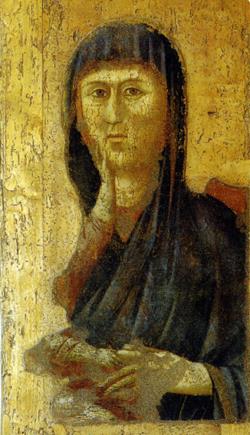
Above photo: screenshot taken from ‘Maestà’ (1290) by Giotto, Pieve di Borgo San Lorenzo (Florence).
An unpublished Giotto presented itself to me on the afternoon of Sunday, November 4th, while I was traveling around Florence: a young librarian from Vespignano, which is Giotto’s birthplace, had pointed out the work to us—a large fragment of a 1290 'Maestà' in the town Pieve of Borgo San Lorenzo, about 30 kilometers from Florence.
The church is beautiful, ancient, simple: upon entering, after a few steps, this panel is clearly visible, soberly framed on the right column before the apse.
Mary's gaze is directed at the visitor, but with an unusual, demanding seriousness, bearing a message completely unfazed by the years that separate us: after a long, precious restoration, it was recently attributed without uncertainty to Giotto[1], who was then just over twenty years old.
Mary lets the child hold her index finger while he caresses her face with his other hand, but her gaze is directed at the viewer and defends marriage—the individual bond that a child attributes without uncertainty to love, and specifically as conjugal love.
Indeed, from that first attribution, it will remain for everyone an essential, though corruptible, reference point for every subsequent goal and achievement: therefore, not to be mocked or trivialized[2].
It is thus, even formally, an alliance, and one that, right from the start, looks not so much at the difference in sex as at the difference in the position of the 'sexes': in short, it also applies to the young daughter toward the woman, it is a satisfied and repeatable desire of the newborn daughter toward the mother, as the desired 'other' relative to her own body.
Very different from the female figures Giotto had accustomed us to - for example, in Padua in the 'Scrovegni Chapel', where he richly sketched the even dramatic motion and beautiful features of Mary, Anna, and Elizabeth - this 'Madonna' instead has stern features and a virile, penetrating gaze: very far from hieratic Byzantine icons, but also from the emerging urban gentlewomen...
What could have been Giotto's thinking here, showing that he knew well the desire of a child and the social threat of its outrage?
This threat passes through the woman, Giotto's wise competence seems to answer, and the generation of a child thus becomes a crucial link between the individual bond indicated by the child and the adult's capacity for elaboration, who is already an adult in society.
In this 'Maestà' it can only be Mary, yet Giotto admits here that the solution of such a woman among his contemporaries was still unthinkable: a woman, indeed, capable of not admitting that female 'lack' that Culture itself blew against him.
Was Giotto afraid of being misunderstood by exposing his thinking and his dismay? The times were not right, Giotto perhaps said to himself, and he chose to wisely defend Mary: but with her, he knew how to defend his own work.
I have therefore called it 'Madonna of the Alliance', perhaps thinking back to another 'madonna' I had observed for a long time in Florence, at the 'Uffizi Gallery', which was the 'Madonna with Child and Angels' from 1465 by Filippo Lippi: delightful, yes, but naive in exposing herself to the insolent mockery of others.
Marina Bilotta Membretti, Cernusco sul Naviglio - November 4, 2018
TutorSalus.net – Freudian journalism
[1] Giotto di Bondone, more simply Giotto, perhaps a diminutive of a longer original name, was born in Vespignano, near Florence, around 1267 and died in Florence in 1337. The painter Cennino Cennini (1370-1427), author of the 'Libro dell'Arte', wrote of him: "He changed the art of painting from Greek into Latin and translated it into modern," referring to Giotto's undisputable overcoming of Byzantine schemes and his introduction of space, volume, and colour, founding values of the subsequent 'Humanism'.
[2] See ‘Inherit from a child. Why not ?’, Marina Bilotta Membretti (2024) NeP edizioni Srls - Roma
Auguste Rodin: praise of envy ??
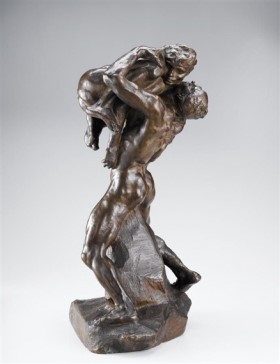
There is a fresco at Villa Maser1 near Treviso, where avarice is represented by an old and nake man, vaguely grinning, who waves a large key at a blonde woman representing generosity, much taller than him and protagonist of the scene : the woman carries a bunfle of ears of mature corn. Between the two it’s clear there is no link, though he tends to her, almost desperately, to be heard. Perhaps she hears him, but is not looking for him.
Visiting the nice exhibition about Auguste Rodin2 at Treviso, cared by Marco Goldin who offered to the public the works of a Master till now hosted only in France, his native country, I’ve thought that a few little statues, well lit and placed but not central in the place, or maybe even considered a little obscure in Rodin’s production, reveal what the artist really thinks of, and with a descriptive precision which the big statues presented at the entrance and in the centre of the exhibition, and representative by now of his whole work at the general public, didn’t have, as a matter of facts.3
The two little statues are : “Je suis belle", of which there seems to be more than a subject, and "Fugit amor"4 : even if both are small in size, they are very elaborate statues - as I hope you can understand from the photo I chose for this article. Unlike the portraits commissioned to him5, these two sculptures reveal a commitment of the author, sincer passionate but dimed by despair.
In "Je suis belle", the undefended naked shape of a man leaps forward holding up in the air a young woman curled up in the fetal position, but escaping his own kiss. An unusual subject indeed, mainly for the years when Rodin lived, who fed on the vital explosion of impressionist painting, open to the disruptive experience towards tradition and enthusiastic of a work ‘en plein air’ and among people, in antithesis to solitary heroism, generous but unsatisfied, of Romantic literature6.
Rodin uses the enthusiasm of Impressionism to slip back into a Romantic illusion, giving up a new solution where indeed Matisse at first, and Picasso7 then involved themselves.
He’s a man full of virility, the one of "Je suis belle", who looks sideways at the woman-foetus who escapes him, so curled up and shown just above his own abdomen : banner of a presumed power which is not given to man, tempting him to an envy that by avarice is generated ?
The representation is plausible of a defense as impetuous as it is naive of sexual authonomy, phallic and romantic, condemned to impotence by the sole refusal from her, who distances her own face from the face of him.
All Rodin’s production revolves around a thought involved, even obsessively, by the creation8 and however also by the human possession which the biblic Creation nothing has to do, because God creates man free to produce one’s own destiny.
Rodin instead fears to miss what he creates, his own biography tells about a greedy humanity and not available to let itself be inherited : his recurrent theme are the hands, yes shaping but also intrusive, possessive, envious of others.
Just like in “Je suis belle”, good title indeed for what the author thinks of the woman who dismisses the man leaving him defenseless to his passions. A melancholy and envious thought which Rodin offers again in “Fugit amor” where the two lovers, like mermaids floating in the sea, elude each other – she always a little ahead of him – in a likewise damned, deadly, unreasonably desired conception of loving thought.
In his melancholy, Rodin envies that presumed sexual autonomy which woman would find in motherwood, an exclusive and coveted place of satisfaction that Nature denies to man.
It surprises the emotional grip which Rodin maintains on contemporary audiences, albeit hyper-connected, algorithmic and digitally cultured but which also testifies the strength of a resistance to judge that goes on to spread naivety, and an easy envy.
Favouring emotion which removes judgement, as a matter of facts Rodin knocks out any solution, human and possible : which Henry Matisse, on the other hand – and shortly after, Picasso too – came to propose profitably.
Marina Bilotta Membretti / Cernusco sul Naviglio - May 28, 2018
1 ‘Villa Maser’ near Treviso, by Andrea Palladio (1508 - 1580), Renaissance highly regarded architect and scene designer, considered one of the most influential personality in Western architecture history.
2 The exhibition (February 24 – June 3, 2018) which rounds off the celebrations for the death’s centenary of Auguste Rodin (1840-1917) was promoted by the Municipality of Treviso, by Marco Goldin and by "Linea d'ombra", which also produced it and organized, with a fine setting at the Museum of ‘Santa Caterina’.
3 "The Cathedral" (1908), "Adam and Eva" (1881), "The thinker" (1880), "The kiss" (1882).
4 "Je suis belle" (1882), "Fugit amor" (1887).
5 "Madame Vicuna" (1884) and other portraits commissioned to Rodin, remain timid and vaguely celebratory works.
6 Ugo Foscolo (1778-1827) in Italy, J.W. Von Goethe (1749-1832) in Germany, V.Hugo ((1802-1885) in France.
7 H.E.B.Matisse (1869-1954); P.Picasso (1881-1973)
8 "The Cathedral" (1908) is represented by two large hands, approached in a singular way to form a welcoming and protecting place.