

Partner of thinking, and lack. Training as a psychoanalyst.
Thinking as a partner
'Madonna of the Alliance'.
An unpublished Giotto.
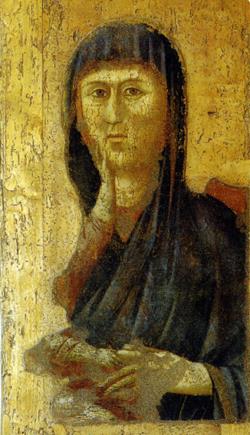
Above photo: screenshot taken from ‘Maestà’ (1290) by Giotto, Pieve di Borgo San Lorenzo (Florence).
An unpublished Giotto presented itself to me on the afternoon of Sunday, November 4th, while I was traveling around Florence: a young librarian from Vespignano, which is Giotto’s birthplace, had pointed out the work to us—a large fragment of a 1290 'Maestà' in the town Pieve of Borgo San Lorenzo, about 30 kilometers from Florence.
The church is beautiful, ancient, simple: upon entering, after a few steps, this panel is clearly visible, soberly framed on the right column before the apse.
Mary's gaze is directed at the visitor, but with an unusual, demanding seriousness, bearing a message completely unfazed by the years that separate us: after a long, precious restoration, it was recently attributed without uncertainty to Giotto[1], who was then just over twenty years old.
Mary lets the child hold her index finger while he caresses her face with his other hand, but her gaze is directed at the viewer and defends marriage—the individual bond that a child attributes without uncertainty to love, and specifically as conjugal love.
Indeed, from that first attribution, it will remain for everyone an essential, though corruptible, reference point for every subsequent goal and achievement: therefore, not to be mocked or trivialized[2].
It is thus, even formally, an alliance, and one that, right from the start, looks not so much at the difference in sex as at the difference in the position of the 'sexes': in short, it also applies to the young daughter toward the woman, it is a satisfied and repeatable desire of the newborn daughter toward the mother, as the desired 'other' relative to her own body.
Very different from the female figures Giotto had accustomed us to - for example, in Padua in the 'Scrovegni Chapel', where he richly sketched the even dramatic motion and beautiful features of Mary, Anna, and Elizabeth - this 'Madonna' instead has stern features and a virile, penetrating gaze: very far from hieratic Byzantine icons, but also from the emerging urban gentlewomen...
What could have been Giotto's thinking here, showing that he knew well the desire of a child and the social threat of its outrage?
This threat passes through the woman, Giotto's wise competence seems to answer, and the generation of a child thus becomes a crucial link between the individual bond indicated by the child and the adult's capacity for elaboration, who is already an adult in society.
In this 'Maestà' it can only be Mary, yet Giotto admits here that the solution of such a woman among his contemporaries was still unthinkable: a woman, indeed, capable of not admitting that female 'lack' that Culture itself blew against him.
Was Giotto afraid of being misunderstood by exposing his thinking and his dismay? The times were not right, Giotto perhaps said to himself, and he chose to wisely defend Mary: but with her, he knew how to defend his own work.
I have therefore called it 'Madonna of the Alliance', perhaps thinking back to another 'madonna' I had observed for a long time in Florence, at the 'Uffizi Gallery', which was the 'Madonna with Child and Angels' from 1465 by Filippo Lippi: delightful, yes, but naive in exposing herself to the insolent mockery of others.
Marina Bilotta Membretti, Cernusco sul Naviglio - November 4, 2018
TutorSalus.net – Freudian journalism
[1] Giotto di Bondone, more simply Giotto, perhaps a diminutive of a longer original name, was born in Vespignano, near Florence, around 1267 and died in Florence in 1337. The painter Cennino Cennini (1370-1427), author of the 'Libro dell'Arte', wrote of him: "He changed the art of painting from Greek into Latin and translated it into modern," referring to Giotto's undisputable overcoming of Byzantine schemes and his introduction of space, volume, and colour, founding values of the subsequent 'Humanism'.
[2] See ‘Inherit from a child. Why not ?’, Marina Bilotta Membretti (2024) NeP edizioni Srls - Roma
Auguste Rodin: praise of envy ??
There is a fresco at Villa Maser1 near Treviso, where avarice is represented by an old and nake man, vaguely grinning, who waves a large key at a blonde woman representing generosity, much taller than him and protagonist of the scene : the woman carries a bunfle of ears of mature corn. Between the two it’s clear there is no link, though he tends to her, almost desperately, to be heard. Perhaps she hears him, but is not looking for him.
Visiting the nice exhibition about Auguste Rodin2 at Treviso, cared by Marco Goldin who offered to the public the works of a Master till now hosted only in France, his native country, I’ve thought that a few little statues, well lit and placed but not central in the place, or maybe even considered a little obscure in Rodin’s production, reveal what the artist really thinks of, and with a descriptive precision which the big statues presented at the entrance and in the centre of the exhibition, and representative by now of his whole work at the general public, didn’t have, as a matter of facts.3
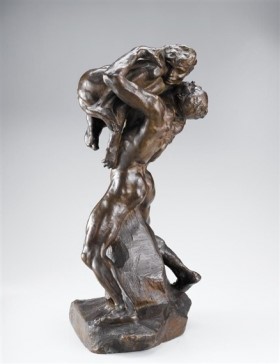
The two little statues are : “Je suis belle", of which there seems to be more than a subject, and "Fugit amor"4 : even if both are small in size, they are very elaborate statues - as I hope you can understand from the photo I chose for this article. Unlike the portraits commissioned to him5, these two sculptures reveal a commitment of the author, sincer passionate but dimed by despair.
In "Je suis belle", the undefended naked shape of a man leaps forward holding up in the air a young woman curled up in the fetal position, but escaping his own kiss. An unusual subject indeed, mainly for the years when Rodin lived, who fed on the vital explosion of impressionist painting, open to the disruptive experience towards tradition and enthusiastic of a work ‘en plein air’ and among people, in antithesis to solitary heroism, generous but unsatisfied, of Romantic literature6.
Rodin uses the enthusiasm of Impressionism to slip back into a Romantic illusion, giving up a new solution where indeed Matisse at first, and Picasso7 then involved themselves.
He’s a man full of virility, the one of "Je suis belle", who looks sideways at the woman-foetus who escapes him, so curled up and shown just above his own abdomen : banner of a presumed power which is not given to man, tempting him to an envy that by avarice is generated ?
The representation is plausible of a defense as impetuous as it is naive of sexual authonomy, phallic and romantic, condemned to impotence by the sole refusal from her, who distances her own face from the face of him.
All Rodin’s production revolves around a thought involved, even obsessively, by the creation8 and however also by the human possession which the biblic Creation nothing has to do, because God creates man free to produce one’s own destiny.
Rodin instead fears to miss what he creates, his own biography tells about a greedy humanity and not available to let itself be inherited : his recurrent theme are the hands, yes shaping but also intrusive, possessive, envious of others.
Just like in “Je suis belle”, good title indeed for what the author thinks of the woman who dismisses the man leaving him defenseless to his passions. A melancholy and envious thought which Rodin offers again in “Fugit amor” where the two lovers, like mermaids floating in the sea, elude each other – she always a little ahead of him – in a likewise damned, deadly, unreasonably desired conception of loving thought.
In his melancholy, Rodin envies that presumed sexual autonomy which woman would find in motherwood, an exclusive and coveted place of satisfaction that Nature denies to man.
It surprises the emotional grip which Rodin maintains on contemporary audiences, albeit hyper-connected, algorithmic and digitally cultured but which also testifies the strength of a resistance to judge that goes on to spread naivety, and an easy envy.
Favouring emotion which removes judgement, as a matter of facts Rodin knocks out any solution, human and possible : which Henry Matisse, on the other hand – and shortly after, Picasso too – came to propose profitably.
Marina Bilotta Membretti / Cernusco sul Naviglio - May 28, 2018
1 ‘Villa Maser’ near Treviso, by Andrea Palladio (1508 - 1580), Renaissance highly regarded architect and scene designer, considered one of the most influential personality in Western architecture history.
2 The exhibition (February 24 – June 3, 2018) which rounds off the celebrations for the death’s centenary of Auguste Rodin (1840-1917) was promoted by the Municipality of Treviso, by Marco Goldin and by "Linea d'ombra", which also produced it and organized, with a fine setting at the Museum of ‘Santa Caterina’.
3 "The Cathedral" (1908), "Adam and Eva" (1881), "The thinker" (1880), "The kiss" (1882).
4 "Je suis belle" (1882), "Fugit amor" (1887).
5 "Madame Vicuna" (1884) and other portraits commissioned to Rodin, remain timid and vaguely celebratory works.
6 Ugo Foscolo (1778-1827) in Italy, J.W. Von Goethe (1749-1832) in Germany, V.Hugo ((1802-1885) in France.
7 H.E.B.Matisse (1869-1954); P.Picasso (1881-1973)
8 "The Cathedral" (1908) is represented by two large hands, approached in a singular way to form a welcoming and protecting place.